Story
Universal Fine-Grained Symmetry Inference and Enforcement for Rigorous Crystal Structure Prediction
Key takeaway
Researchers developed a new AI system that can accurately predict the atomic structure of crystals, which is crucial for designing new materials with desired properties.
Quick Explainer
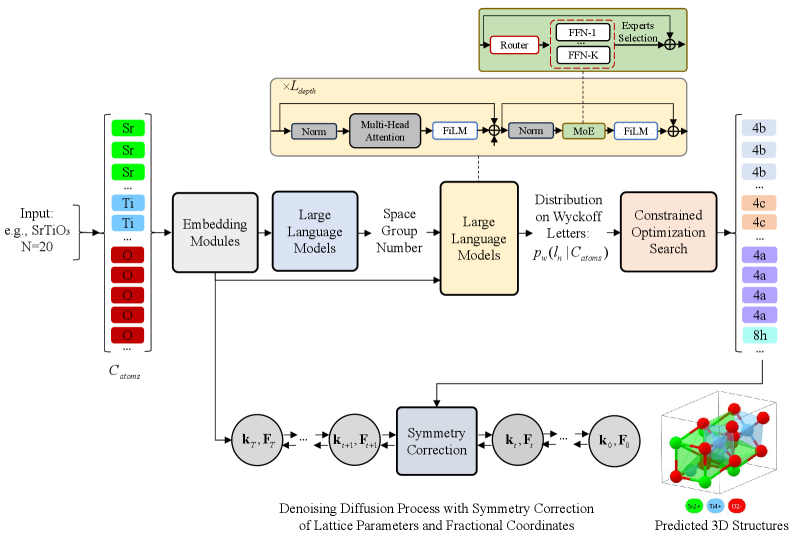
The core idea is to directly infer and enforce the precise crystallographic symmetry of predicted atomic structures, rather than treating it as a soft constraint. Two language models predict the most likely space group and Wyckoff site assignments, which are then used to rigorously optimize the structure while strictly adhering to the symmetry constraints. This symmetry-driven approach enables the model to explore uncharted chemical space while ensuring physical plausibility, resolving the trade-off between structural fidelity and novelty that limits previous crystal structure prediction methods.
Deep Dive
Technical Deep Dive: Universal Fine-Grained Symmetry Inference and Enforcement for Rigorous Crystal Structure Prediction
Problem & Context
- Crystal structure prediction (CSP) aims to determine the 3D atomic arrangement of a crystal given its composition
- Existing deep learning models often treat crystallographic symmetry only as a soft heuristic or rely on space group and Wyckoff templates retrieved from known structures
- This limits physical fidelity and the ability to discover genuinely new material structures
Methodology
Symmetry Inference
- Two large language models (LLMs) are used to directly infer fine-grained crystallographic symmetry from compositional inputs:
- LLM_g predicts the probability distribution over the 230 crystallographic space groups
- LLM_w predicts the probability distribution over Wyckoff letters compatible with the predicted space group
Symmetry Enforcement
- The predicted Wyckoff letter assignment is formulated as a constrained optimization problem to strictly enforce algebraic consistency between site multiplicities and atomic stoichiometry
- A constrained beam search algorithm is employed to efficiently solve this optimization problem
Diffusion Rectification
- The predicted space group and Wyckoff symmetries are used to rectify the lattice and fractional coordinates at each denoising step of the diffusion-based structure generation
- This ensures the generated structures strictly adhere to the target symmetry constraints
Data & Experimental Setup
- Experiments conducted on three standard CSP benchmark datasets:
- Perov-5: 18,928 perovskite-type structures
- MP-20: 45,231 experimentally verified materials from Materials Project
- MPTS-52: 40,476 structures with up to 52 atoms per unit cell
Results
Stability, Uniqueness, and Novelty (SUN) Metrics
- Significant improvements over the DiffCSP++ baseline across all three benchmarks:
- On MP-20, stability and novelty improved by 124% and 71% respectively
- On the challenging MPTS-52 dataset, stability and novelty improved by 255% and 53% respectively
- Overall SUN metric improved by 376% on MPTS-52
Matching Rate
- Consistently achieves state-of-the-art performance in reconstructing known ground-truth structures across all three benchmarks
- Demonstrates the framework's ability to balance exploration and exploitation, covering both known and novel materials
Interpretation
- The symmetry-driven approach outperforms the retrieval-based baseline by transitioning from memorization to generative reasoning
- By directly inferring valid Wyckoff patterns from composition and enforcing algebraic consistency, the model can explore uncharted chemical space while guaranteeing physical plausibility
- This resolves the trade-off between structural fidelity and novelty, enabling both recovery of known ground-truth structures and proposition of novel, stable polymorphs
Limitations & Uncertainties
- While the results demonstrate significant improvements, there is still room for further enhancing the framework's performance, especially on datasets with larger and more complex unit cells
- The proposed approach relies on the availability of accurate space group and Wyckoff predictions, which can be sensitive to model architecture and training data quality
What Comes Next
- Investigate methods to further improve the robustness and scalability of the symmetry inference models, potentially by incorporating domain-specific priors or multi-modal inputs
- Explore ways to seamlessly integrate the symmetry-driven generation with the diffusion backbone, enabling end-to-end optimization of the entire pipeline
- Expand the framework to handle other structural constraints beyond crystallographic symmetry, such as local coordination environments and interatomic potentials