Story
A fully differentiable framework for training proxy Exchange Correlation Functionals for periodic systems
Key takeaway
Researchers developed a more efficient way to simulate material properties using machine learning, which could lead to faster and more accurate predictions for applications like batteries and solar cells.
Quick Explainer
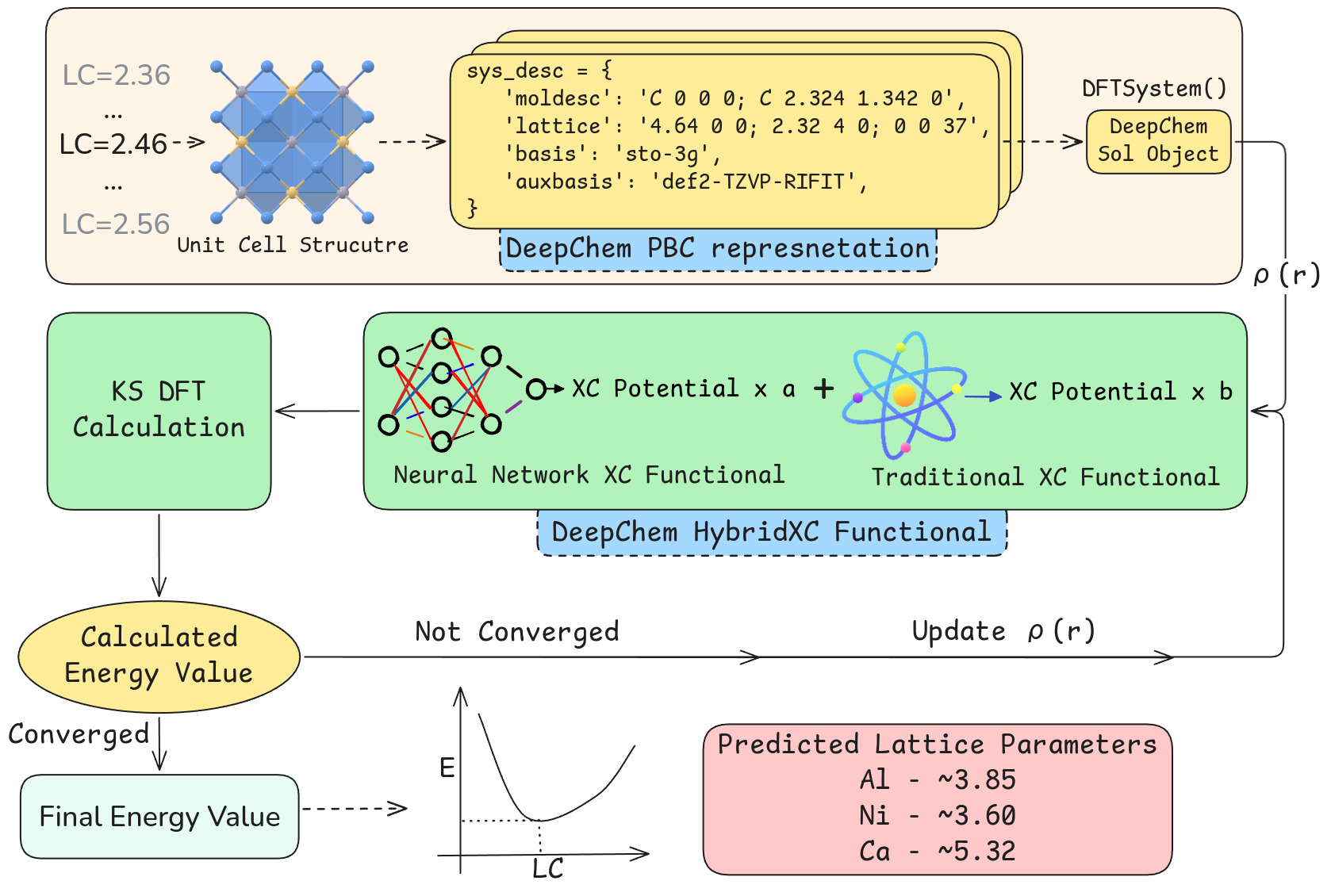
This work presents a differentiable framework that integrates machine learning models as drop-in replacements for traditional exchange-correlation functionals in density functional theory (DFT) calculations for periodic systems. The key idea is to couple a multi-layer perceptron neural network with a traditional generalized gradient approximation functional, enabling end-to-end optimization of the learned model within a periodic DFT workflow. This hybrid approach allows training proxy ML models to approximate DFT-level accuracy more efficiently, while maintaining a tight coupling between the ML components and the underlying physics. The framework extends prior work on molecular systems by natively supporting periodic boundary conditions and crystalline materials.
Deep Dive
Technical Deep Dive: A Fully Differentiable DFT Framework for Periodic Systems
Overview
This work introduces a differentiable framework for integrating machine learning models as drop-in replacements for traditional exchange-correlation (XC) functionals in density functional theory (DFT) calculations for periodic systems. The key contributions are:
- A fully differentiable DFT implementation in Python using PyTorch, enabling end-to-end optimization of learned XC functionals.
- Integration with the DeepChem library to leverage established ML models and tools.
- Native support for periodic boundary conditions and crystalline materials, extending prior work on molecular systems.
This allows training proxy ML models to approximate DFT-level accuracy at a fraction of the computational cost, while maintaining a tight coupling between the ML models and the underlying physics.
Methodology
The framework uses a hybrid approach, coupling a multi-layer perceptron (MLP) with a traditional generalized gradient approximation (GGA) XC functional. This hybrid functional is then incorporated into a periodic DFT workflow to perform lattice parameter optimization.
The dataset used for training consists of face-centered cubic (FCC) crystal structures from the Materials Project database. To represent periodic systems, the framework extends the existing DeepChem data structures with lattice geometry and basis information.
The training objective is to minimize the difference between the total energies predicted by the hybrid DFT+NN model and the reference DFT calculations performed using established packages like GPAW and PySCF.
Results
The proposed DFT+NN framework was evaluated on aluminum (Al), nickel (Ni), and calcium (Ca) systems. The predicted lattice constants showed a relative error of 5-10% compared to the reference DFT calculations.
However, the framework did not yield physically meaningful predictions for graphene, highlighting current limitations in handling certain classes of materials.
Limitations & Uncertainties
- The framework struggles with more complex periodic systems like graphene, suggesting the need for further improvements to the underlying DFT implementation.
- The authors suspect that transitioning to a plane wave basis set, which is better suited for periodic systems, could resolve many of the observed issues.
- The use of stricter basis sets and XC functionals in the reference calculations may have contributed to the inconsistencies observed in the PySCF results at certain lattice constants.
Future Work
The authors propose adopting a plane wave basis as a natural extension to the current differentiable DFT framework. Plane waves provide a systematic and scalable representation of periodic systems, with potential benefits for handling metallic and low-dimensional materials.
Sources: