Story
Point-DeepONet: Predicting Nonlinear Fields on Non-Parametric Geometries under Variable Load Conditions
Key takeaway
Researchers developed Point-DeepONet, a new AI algorithm that can accurately predict how complex structures respond to different loads, without needing extensive simulations. This could lead to faster and more efficient structural design and analysis in engineering.
Quick Explainer
Point-DeepONet is a novel neural network architecture that integrates geometric information from raw point cloud data with global physical parameters to enable accurate and efficient prediction of displacement and stress fields on complex, non-parametric 3D structures under nonlinear loading conditions. By combining PointNet's ability to encode geometric details with DeepONet's capacity to capture local-global coupling, Point-DeepONet overcomes key challenges in traditional nonlinear finite element analysis. This approach allows for scalable and robust surrogate modeling of nonlinear structural responses, unlocking new possibilities for design optimization and uncertainty quantification on complex engineering systems.
Deep Dive
Point-DeepONet: Predicting Nonlinear Fields on Non-Parametric Geometries under Variable Load Conditions
Overview
This paper presents Point-DeepONet, a novel neural network architecture that integrates PointNet into the DeepONet framework. This approach enables accurate, efficient, and scalable predictions of displacement and stress fields directly on unstructured finite element meshes, overcoming key challenges in nonlinear elastoplastic analyses of non-parametric, three-dimensional geometries.
Methodology
Dataset Generation
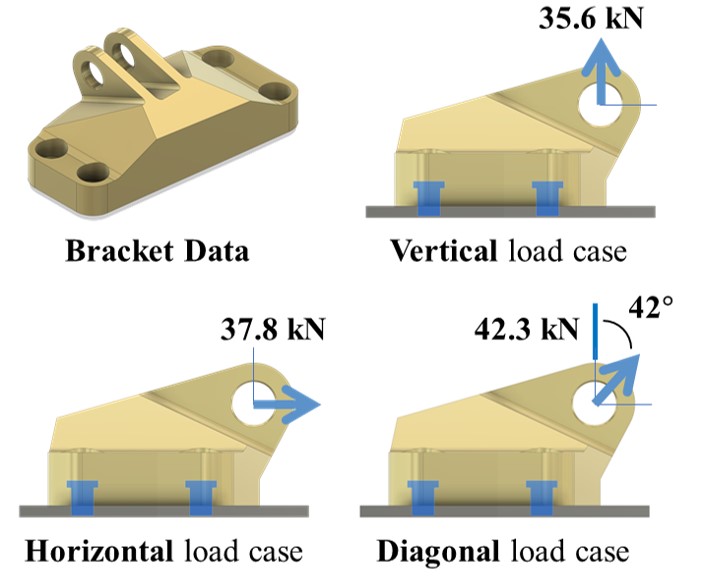
- Utilized the DeepJEB dataset, a synthetic dataset for 3D deep learning in structural mechanics
- Performed nonlinear static finite element analyses using Altair OptiStruct to simulate structural response under nonlinear conditions
- Employed an elastic-plastic material model with linear isotropic hardening to capture nonlinear behavior
Data Preprocessing
- Preprocessed data by computing signed distance functions (SDFs) for each geometry
- Split the dataset into 80% training and 20% validation subsets
Model Architecture
- Proposed Point-DeepONet, which integrates PointNet into the DeepONet framework
- PointNet encodes geometric information from raw point clouds
- DeepONet's branch network encodes global physical parameters
- Combining the geometric and physical encodings using element-wise multiplication enables the model to capture local-global coupling
- SIREN layers in the trunk network effectively represent high-frequency details
Results and Discussion
Prediction Results
- Compared the performance of PointNet, DeepONet, and Point-DeepONet
- Point-DeepONet consistently outperformed the other models, achieving higher accuracy and robustness
- Provided visualizations of the models' predictions compared to finite element analysis (FEA) results
Influence of Resampling Size
- Investigated the effect of resampling size on the models' predictive accuracy
- Larger resampling sizes improved the models' ability to capture local geometric details and stress concentrations
Influence of Dataset Size
- Examined how the size of the dataset influenced the performance and training time of PointNet and Point-DeepONet
- Point-DeepONet scaled more efficiently with larger datasets and became more advantageous in both accuracy and computational cost
Ablation Study and Architectural Validation
- Performed an ablation study to validate the contribution of key architectural components
- Confirmed the importance of the SIREN layers and the element-wise fusion mechanism
Validation of Generalization to Unseen Load Conditions
- Evaluated the model's ability to generalize across both load directions and magnitudes
- Point-DeepONet maintained high accuracy on a new test set with randomly sampled load conditions
Limitations and Future Work
- Extend Point-DeepONet to handle a wider range of material models, including anisotropic and composite materials
- Explore temporal extensions to predict transient responses under dynamic loading conditions
- Investigate adaptive point sampling strategies and advanced geometric feature extractors to improve accuracy for complex geometries
- Explore transfer learning techniques to enable efficient adaptation to new geometries and load conditions
Conclusion
Point-DeepONet represents a significant advancement in operator learning-based surrogate modeling, offering accurate, efficient, and scalable predictions for nonlinear structural analyses on non-parametric 3D geometries under variable load conditions.