Story
Integrated memristor for mitigating reverse-bias in perovskite solar cells
Key takeaway
Integrated memristors could help improve the reliability of perovskite solar cells by protecting them from damage caused by partial shading.
Quick Explainer
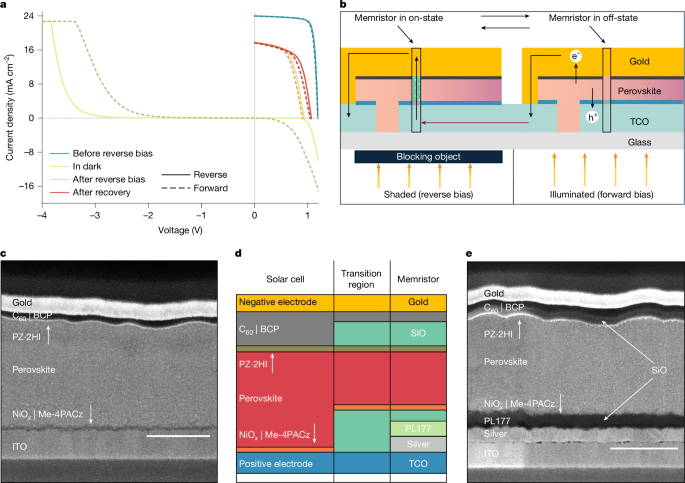
The Memsol combines a perovskite solar cell with an integrated memristor to address the critical reverse-bias instability issue that has limited real-world deployment of perovskite technologies. The memristor can toggle between a low-resistance bypass state and the high-efficiency solar cell state, depending on the illumination and bias conditions. This allows the Memsol to automatically switch to bypass mode when subjected to reverse bias, preventing degradation of the solar cell. The seamless integration of the memristor within or adjacent to the solar cell, along with careful engineering of the layers, enables the Memsol to maintain exceptional performance metrics comparable to state-of-the-art perovskite solar cells.
Deep Dive
Technical Deep Dive: Integrated Memristor for Perovskite Solar Cells
Overview
This work presents a novel solar cell concept called the "Memsol", which integrates a memristor directly into a perovskite solar cell. The key innovation is using the memristor to protect the solar cell from reverse-bias instability, a critical issue that has limited the real-world deployment of perovskite solar technologies.
Problem & Context
Perovskite solar cells (PSCs) have achieved power conversion efficiencies comparable to established photovoltaic technologies like silicon. However, PSCs suffer from poor stability under moderate reverse bias, which can occur in real-world conditions like partial shading or series-connected modules. Prior approaches have focused on engineering the device architecture to enhance the breakdown voltage, but these have had limited success.
Methodology
The researchers developed the Memsol, which combines a solar cell and a memristor into a single integrated device. The memristor is fabricated using an additional metal-insulator stack that shares the perovskite absorber and electrodes with the solar cell portion.
The key aspects of the Memsol design are:
- The memristor can toggle between a low-resistance bypass state and the high-efficiency solar cell state, depending on the illumination and bias conditions.
- The memristor is either placed within the solar cell active area or adjacent to it, enabling seamless integration.
- Careful engineering of the perovskite and contact layers to maintain high solar cell performance.
Data & Experimental Setup
The researchers fabricated and characterized multiple Memsol devices, comparing them to reference perovskite solar cells without the integrated memristor. Key experiments include:
- Current-voltage measurements under illumination and reverse bias conditions
- Transient switching response of the memristor
- Incident photon-to-current efficiency (IPCE) and electroluminescence (EL) spectra
- Thermal imaging under reverse bias
- Long-term cycling and thermal stability testing
Results
The Memsol devices demonstrated several key advantages over the reference perovskite solar cells:
- Maintained stable performance under reverse bias and shading conditions, with no degradation in power conversion efficiency (PCE).
- Exceptional PCE up to 22.5%, with open-circuit voltages over 1.2 V, short-circuit currents of 23 mA/cm², and fill factors up to 0.80.
- Memristor switching times in the 10-40 ns range, enabling rapid toggling between solar cell and bypass modes.
- Negligible power losses from the memristor's off-state leakage current.
- Stable performance under thermal aging at 65°C in the dark.
The researchers also demonstrated a 9-cell Memsol mini-module, showing the scalability of the technology.
Interpretation
The Memsol represents a significant advance in perovskite solar cell technology, providing a comprehensive solution to the critical reverse-bias instability issue. By integrating the memristor, the solar cells can automatically switch to a low-resistance bypass mode when subjected to reverse bias, preventing degradation.
The exceptional performance metrics achieved, including high efficiency, voltage, and fill factor, demonstrate the viability of the Memsol design. The rapid switching speeds and negligible leakage current indicate the memristor integration can be accomplished without compromising solar cell performance.
Limitations & Uncertainties
While the Memsol shows great promise, some key limitations and uncertainties remain:
- Long-term operational stability under real-world environmental stresses beyond thermal aging was not assessed.
- The impact of the memristor integration on manufacturing cost and complexity is unclear.
- The scalability to large-area modules beyond the 9-cell prototype was not demonstrated.
What Comes Next
The researchers anticipate that the Memsol concept will accelerate the commercialization of perovskite solar technologies by solving the critical reverse-bias instability issue. Future work should focus on further optimizing the integrated memristor, scaling to large-area modules, and demonstrating long-term reliability under outdoor operating conditions.
Sources: