Story
Towards quantum-enhanced long-baseline optical/near-IR interferometry
Key takeaway
Researchers developed a technique to transport weakly coherent photons over long distances, paving the way for advanced telescopes that could see finer details in distant stars and galaxies.
Quick Explainer
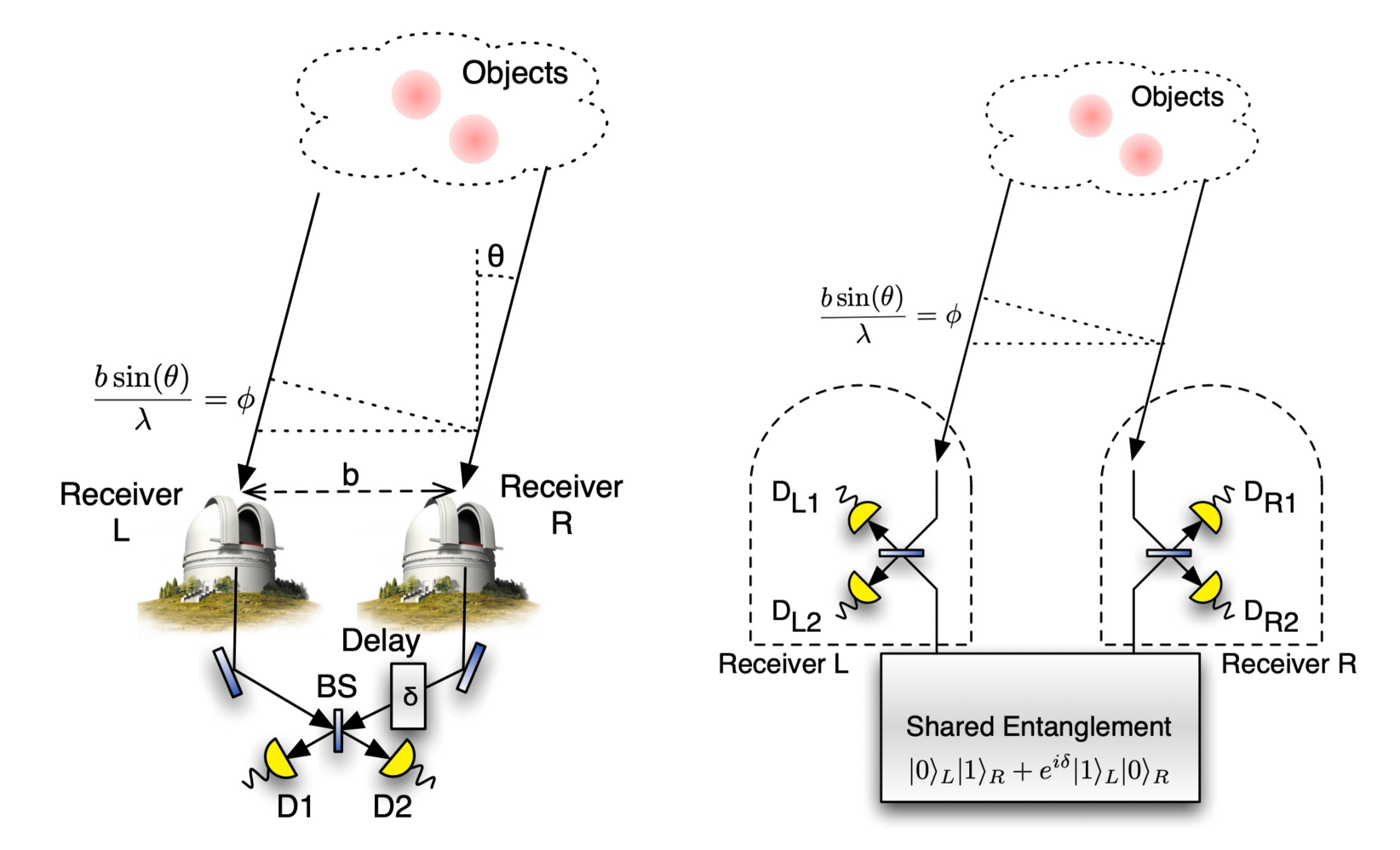
Quantum-enhanced optical interferometry aims to overcome the key limitations of classical long-baseline interferometry, which struggles to achieve the required microarcsecond angular resolution for breakthrough astronomical research. The core idea is to use quantum entanglement between photons at the telescope apertures as a shared resource. This allows reconstructing the wavefront phase and mitigating transmission losses, without the need for physically transporting the weakly coherent photon states over the long baselines. Two main protocols are proposed - the Gottesman protocol using continuously refreshed entanglement, and the Khabiboulline protocol leveraging quantum memories to reduce the entanglement rate requirement. These approaches have demonstrated important proof-of-principle results, but require further progress on technical challenges like high-fidelity entanglement generation and precise synchronization between telescope sites.
Deep Dive
Technical Deep Dive: Towards Quantum-Enhanced Long-Baseline Optical/Near-IR Interferometry
Overview
This work explores the use of quantum-enhanced techniques to overcome the key limitations of classical optical/infrared long-baseline interferometry, with the goal of achieving microarcsecond angular resolution. The authors report on an initiative launched by the NSF's NOIRLab to collaborate with the University of Arizona's Center for Quantum Networks and Arizona Quantum Initiative on these concepts.
Problem & Context
Optical and infrared long-baseline interferometry can achieve milliarcsecond angular resolutions, but extending to microarcsecond scales required for breakthrough astronomical research is challenging with classical methods. Key limitations include:
- Photon loss and phase errors over the long baselines required for microarcsecond resolution
- Difficulty in efficiently transporting and combining weakly coherent photon states over kilometer-scale baselines
- Compensating for the large differential optical path differences across a telescope array
Quantum-Enhanced Interferometry Approaches
The authors review two main quantum-enhanced interferometry protocols proposed to address these limitations:
Gottesman Protocol
- Uses entangled photon pairs as a shared resource between the telescope apertures
- Interference measurements at each site allow reconstructing the wavefront phase
- Major challenge is the need for a very high rate (>10 GHz) of continuously refreshed entangled states
Khabiboulline Protocol
- Uses quantum memories at each site to mitigate the entanglement rate requirement
- Photon arrival time is encoded in the quantum memory, and entanglement is used to identify the occupied time bin
- This "teleports" the astronomical photon state between apertures without physical transmission
Both protocols have the potential to overcome the transmission loss and optical path difference compensation issues of classical interferometry.
Experimental Progress
The authors summarize several recent demonstrations:
- Gottesman protocol: Table-top proof-of-principle experiment using entangled photons and a simulated double-slit target.
- Khabiboulline protocol: 40 km field test distributing entanglement between two quantum memory nodes, demonstrating fidelities above 0.5 for 500 ms.
These represent important steps, but further progress is needed on critical technical requirements like entanglement rate, memory lifetime, and synchronization.
Roadmap for On-Sky Demonstration
The authors outline a phased approach for an on-sky demonstration:
- Implement the Gottesman protocol using a single telescope split into two apertures.
- Scale to the Khabiboulline protocol at an existing optical interferometer array like CHARA.
These demonstrations would be carried out in a laboratory setting, with the telescope providing the stellar photons via single-mode fibers to a controlled environment.
Limitations & Uncertainties
The key technical challenges that must be addressed include:
- Generating high-rate, high-fidelity entangled states
- Achieving the necessary timing precision and accuracy for loading photons into quantum memories
- Maintaining synchronization between the telescope sites
- Scaling the quantum memory lifetime and number of qubits
The authors note that while the Gottesman protocol is more technologically mature, the Khabiboulline protocol's lower entanglement rate requirement is a significant advantage.
What Comes Next
The authors are launching a new "Quantum Telescope Initiative" to facilitate the development of a quantum-enhanced telescope, with the near-term goal of an on-sky demonstration within 5 years. Ongoing collaboration between the astronomy and quantum information science communities will be crucial to realizing this vision.