Story
Algebraic Quantum Intelligence: A New Framework for Reproducible Machine Creativity
Key takeaway
Researchers developed a new approach to AI that can generate more creative and reproducible text by incorporating principles from quantum computing. This could lead to more advanced language models that can produce more novel and meaningful content.
Quick Explainer
The paper proposes Algebraic Quantum Intelligence (AQI), a new framework that models machine creativity using noncommutative algebraic structures. AQI represents semantic states as vectors and updates them via noncommuting "operator" transformations, ensuring a minimum breadth of exploration in the semantic space. This two-layer architecture with "state update" and "operator update" components allows systematic control over the creative process. The key innovation is that the noncommutativity of operator updates prevents deterministic convergence, a limitation of existing large language models. Experiments show AQI outperforming baselines on creative reasoning benchmarks, with performance gains attributed to its noncommutative algebraic design rather than just increased randomness.
Deep Dive
Technical Deep Dive: Algebraic Quantum Intelligence
Overview
This paper proposes "Algebraic Quantum Intelligence" (AQI) as a new theoretical and computational framework for reproducible machine creativity. The key insights are:
- Existing large language models (LLMs) suffer from "deterministic convergence" - as context accumulates, their semantic generation becomes increasingly constrained and loses creativity.
- AQI addresses this by introducing noncommutative algebraic structures, which guarantee a minimum "breadth of exploration" in semantic space through order effects, interference, and uncertainty.
- The AQI framework is implemented as a two-layer architecture with "state update" and "operator update" components, allowing systematic control over creativity.
- Experiments show AQI consistently outperforms strong baselines on creative reasoning benchmarks, with performance gains attributable to its noncommutative algebraic design rather than just increased randomness.
Methodology
Key Principles
- AQI represents semantic states as vectors in a Hilbert space, and updates them via noncommuting "operator" transformations.
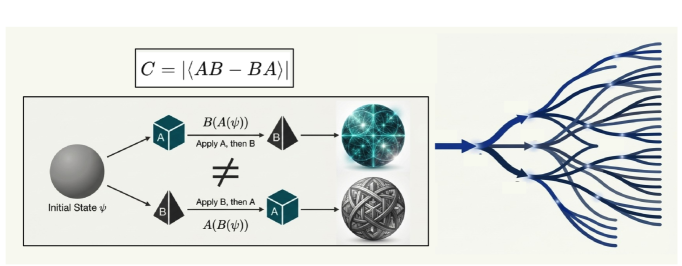
- Noncommutativity (AB ≠ BA) ensures coexistence and divergence of multiple semantic possibilities, preventing deterministic convergence.
- The "Creativity Value" (C-value) quantifies this divergence, providing a lower bound on creativity.
- The C-value is defined as the absolute expectation of the commutator: C = |⟨AB - BA⟩|.
Implementation
- AQI has a two-layer architecture:
- The "S-Generator" updates the semantic state vector based on the current state and a dynamically generated "creative Hamiltonian".
- The "H-Generator" adaptively constructs the Hamiltonian based on the current state and previous dynamics.
- This enables iterative, noncommutative evolution of the semantic state.
- The state vector and operators are represented in finite-dimensional real vector spaces, while preserving key quantum-theoretic properties.
Experiments & Results
Creativity Evaluation
- Evaluated AQI on a new benchmark of 10 creative reasoning domains relevant to business and policy decision-making.
- Responses were scored by an ensemble of large language models on two axes:
- Creativity of the generated content (C_x)
- Creativity expansion from the recipient's perspective (C_y)
- The "Co-Creativity Index" (CCI) combines these, defined as the average of min(Cx, Cy).
- Across all 10 domains, AQI outperformed 14 strong baseline models by an average of +27 T-score points on CCI.
Noncommutativity Effects
- Compared output distributions for two operator sequences (A→B and B→A) under identical conditions.
- Found the distributions formed clearly separated, non-overlapping clusters, demonstrating systematic divergence due to operator order.
- This shows the performance gains are not from increased randomness, but the noncommutative algebraic structure.
Interference Effects
- Analyzed how the composition of sequential operators differs from simple vector addition.
- Defined metrics based on correlation coefficients to detect interference-like phenomena.
- Empirically observed substantial decreases in correlation that cannot be explained by commutative composition, indicating selective amplification and suppression of semantic components.
Interpretation
- AQI formalizes creativity not as accidental deviation, but as a dynamical property stemming from noncommutative algebraic structures.
- It provides a theoretical guarantee of a lower bound on exploration width in semantic space, addressing the deterministic convergence issue in existing LLMs.
- The experiments demonstrate that AQI's effectiveness arises from its core noncommutative design principles, not just increased randomness.
- This suggests AQI can serve as a foundation for systematically designing and controlling machine creativity, beyond current approaches.
Limitations & Uncertainties
- The specific operator sets and Hamiltonian control strategies implemented cannot be fully disclosed due to intellectual property constraints.
- Social creativity involves complex factors like power structures and embodied unpredictability, which the current algebraic framework can only treat implicitly.
- Integrating AQI with situated knowledge and social practice remains an open challenge in bridging theory and real-world application.
What Comes Next
Future work is expected to advance in three directions:
- Hybrid modeling that integrates complex social and embodied aspects of creativity.
- Iterative validation in real-world settings and dynamic model adaptation.
- Exploration of new epistemic frontiers co-created by creative AI agents and humans.