Story
FRSICL: LLM-Enabled In-Context Learning Flight Resource Allocation for Fresh Data Collection in UAV-Assisted Wildfire Monitoring
Key takeaway
Researchers developed a system to improve data collection by UAVs monitoring wildfires, which could help detect and respond to wildfires faster, reducing environmental damage.
Quick Explainer
FRSICL is a novel approach that combines Large Language Models (LLMs) and In-Context Learning to optimize the data collection schedule and velocity of a UAV monitoring a network of ground sensors. By analyzing the current state of the system, the LLM generates optimized schedules and velocity profiles that aim to minimize the average Age of Information (AoI) across the sensor network. The system iteratively refines these decisions based on performance feedback, ensuring safety constraints are met. This structured, training-free approach improves upon conventional deep reinforcement learning methods by providing more transparent and reproducible decision-making, highlighting the potential of LLM-enabled techniques for enhancing the responsiveness and reliability of time-critical UAV applications like wildfire monitoring.
Deep Dive
Technical Deep Dive: FRSICL for LLM-Enabled UAV-Assisted Wildfire Monitoring
Overview
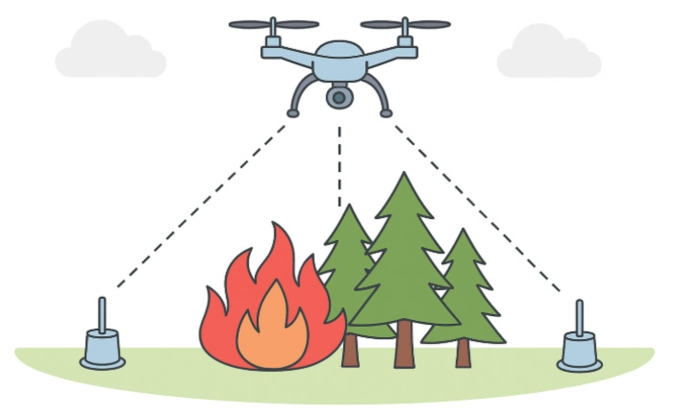
The paper proposes a novel "Flight Resource Allocation scheme using LLM-Enabled In-Context Learning (FRSICL)" for UAV-Assisted Wildfire Monitoring (UAWM) systems. FRSICL aims to minimize the average Age of Information (AoI) across a network of ground sensors by jointly optimizing the UAV's data collection schedule and velocity.
Problem & Context
- Uncrewed Aerial Vehicles (UAVs) play a vital role in wildfire monitoring by collecting real-time sensor data from distributed ground stations.
- Timely data collection is critical, as outdated information can lead to inaccurate situational awareness and put responders at risk.
- The Age of Information (AoI) metric quantifies data freshness by measuring the time difference between the current time and the generation timestamp of the last sensor measurement received.
- Jointly optimizing the UAV's data collection schedule and velocity is challenging, as aggressive maneuvers can degrade link quality, while overly conservative movements extend mission time and delay data acquisition.
Methodology
- FRSICL leverages Large Language Models (LLMs) and In-Context Learning (ICL) to address the joint optimization problem.
- The system uses an edge-hosted LLM to:
- Analyze the current state (AoI, channel conditions, UAV location)
- Generate optimized data collection schedules and UAV velocities
- Iteratively improve decisions based on performance feedback
- Safety constraints are explicitly embedded into the scheduling logic, including:
- Velocity-constrained decision making
- Channel-aware sensor selection
- Diversity-preserving scheduling rules
Data & Experimental Setup
- Simulations consider a scenario with 10 randomly placed ground sensors in a 100m x 100m area.
- The proposed FRSICL is compared against baselines such as Proximal Policy Optimization (PPO), Block Coordinate Descent (BCD), Nearest Neighbor, Genetic Algorithm, and Deep Q-Network.
- Key parameters include maximum UAV velocity (15 m/s), maximum transmit power (100 mW), and 30 time steps per episode.
Results
- FRSICL significantly outperforms the baselines, achieving faster convergence and lower average AoI (around 5-6 seconds).
- FRSICL with the more capable o3-mini LLM outperforms the GPT-4O-mini version.
- As the number of sensors increases from 5 to 15, FRSICL maintains a lower AoI than the Nearest Neighbor baseline.
- Compared to PPO, FRSICL exhibits more stable and efficient UAV velocity profiles, avoiding abrupt changes.
Interpretation
- FRSICL's advantages over conventional DRL methods stem from its training-free adaptation, iterative policy refinement, and transparent decision-making.
- The structured, prompt-based approach of FRSICL improves reproducibility and interpretability compared to opaque, hyperparameter-dependent DRL.
- The performance gains of FRSICL highlight the potential of LLM-enabled ICL for enhancing the responsiveness and reliability of UAV systems in time-critical applications like wildfire monitoring.
Limitations & Uncertainties
- The study is limited to a single UAV scenario, while real-world UAWM may involve multiple coordinated UAVs.
- The proposed model assumes a fixed UAV trajectory, whereas dynamic path planning could further improve performance.
- The impact of LLM vulnerabilities, such as prompt injection attacks, on the reliability of FRSICL requires further investigation.
What Comes Next
- Future research will explore extending FRSICL to multi-UAV coordination strategies, incorporating dynamic path planning, and addressing LLM security challenges.
- Experimental validation on real-world UAWM deployments would provide valuable insights into the practical applicability and performance of the proposed framework.