Story
Eigenmood Space: Uncertainty-Aware Spectral Graph Analysis of Psychological Patterns in Classical Persian Poetry
Key takeaway
Researchers developed a new algorithm that can analyze patterns of emotion and psychology hidden within classical Persian poetry, offering a new way to understand the emotional lives of people long ago.
Quick Explainer
This work proposes an uncertainty-aware computational framework for modeling psychological patterns in classical Persian poetry at scale. The key idea is to annotate individual poetic verses with psychological concepts, aggregate these annotations into a "Eigenmood" representation for each poet, and then quantify the divergence of each poet's profile from a global baseline. This allows capturing both the distributional prevalence and relational structure of affective configurations, while preserving uncertainty through abstention and confidence weighting. The framework combines distant reading summaries with targeted close reading, providing both macro-scale comparisons and verse-level exemplars to support cultural-psychological modeling of the poetic tradition.
Deep Dive
Technical Deep Dive: Eigenmood Space
Overview
This work presents an uncertainty-aware computational framework for analyzing psychological patterns in classical Persian poetry at scale. The key contributions are:
- Developing a multi-label psychological ontology to map individual poetic verses to recurring affective configurations.
- Aggregating verse-level annotations into a poet-level "Eigenmood" representation that captures both distributional prevalence and relational structure.
- Quantifying "poetic individuality" as divergence from a global baseline, while preserving uncertainty through abstention and confidence weighting.
- Validating the framework against human judgments and demonstrating its ability to support both distant reading summaries and targeted close reading.
Problem & Context
Classical Persian poetry is a sustained archive of affective expression through metaphor, convention, and rhetorical indirection. This makes close reading indispensable but limits reproducible comparison at scale. The authors introduce an uncertainty-aware computational approach to model psychological patterns across tens of thousands of verses.
Methodology
- Verse-level annotations: Annotate each verse with a set of psychological concepts (e.g., melancholia, romantic obsession) along with confidence scores and abstention flags.
- Poet-level aggregation: Aggregate the verse-level annotations into a Poet × Concept matrix, representing each poet as a probability distribution over concepts.
- Individuality quantification: Measure the divergence of each poet's distribution from a global baseline using Jensen-Shannon divergence and Kullback-Leibler divergence.
- Relational structure modeling: Build a confidence-weighted concept co-occurrence graph and derive an "Eigenmood" embedding through Laplacian spectral decomposition.
Data & Experimental Setup
- Corpus: 61,573 verses across 10 poets, drawn from the Ganjoor digital corpus.
- Annotation ontology: 9 psychological constructs, including melancholia, romantic obsession, and spiritual narcissism.
- Validation: A stratified sample of 500 verses annotated by two independent human experts to assess label reliability, abstention appropriateness, and confidence calibration.
Results
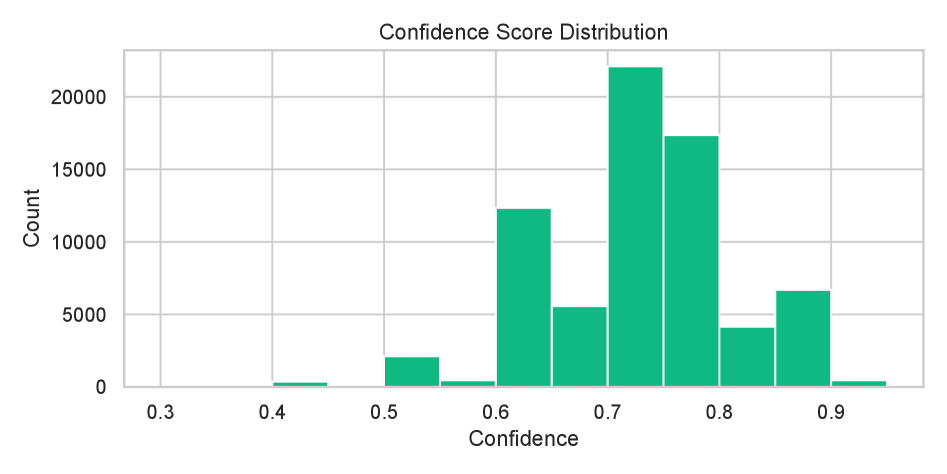
- Substantial uncertainty: 22.2% of verses are abstained, indicating the analytical importance of uncertainty modeling.
- Heterogeneous individuality: Poets exhibit varying degrees of divergence from the global baseline, ranging from Khayyam and Parvin as high-distance outliers to Hafez and Shahriar as baseline-adjacent.
- Relational structure matters: The Eigenmood embedding captures directional contrasts in concept coupling that are not apparent from marginal prevalence alone.
Interpretation
- The profiles model recurring rhetorical-affective configurations in poetic discourse, not clinical diagnoses of historical individuals.
- Divergence and Eigenmood patterns support probabilistic cultural-psychological modeling, identifying differential tendencies across poets without collapsing the tradition into monocausal claims.
- The framework combines distant reading summaries with targeted close reading, providing both macro-scale comparisons and verse-level exemplars.
Limitations & Uncertainties
- The psychological ontology is an operational construct, not a latent clinical taxonomy. Its validity depends on prompt design, model training data, and cultural-semantic fit.
- Abstention is not a nuisance but a substantive property, introducing selection bias that must be diagnosed and reported.
- Small subcorpora (e.g., Khayyam) require careful interpretation of point estimates due to finite sample effects.
What Comes Next
- Exploring alternative graph constructions, richer metadata, and cross-corpus transfer to other literary traditions.
- Expanding the evidentiary horizon while preserving interpretive caution, enabling robust comparative claims and transparent pathways from macro structure to inspectable verse evidence.