Story
Cold-injection synthesis of highly emissive perovskite nanocrystals
Key takeaway
Researchers developed an improved way to make tiny light-emitting crystals that could lead to brighter, more efficient displays and lighting.
Quick Explainer
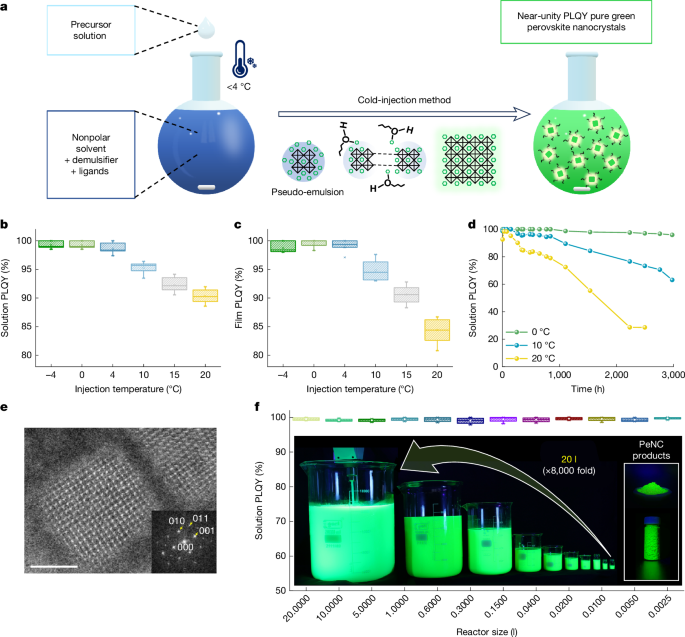
The key insight of the cold-injection (Ci) method is that slowing down the assembly of perovskite precursor materials is essential for producing highly efficient perovskite nanocrystals (PeNCs). By injecting the precursor solutions at temperatures below 4°C, the Ci method triggers a slow formation of fully coordinated plumbates, which then assemble into PeNCs with minimal defects. This slow, temperature-assisted assembly process is the critical innovation that enables the Ci method to consistently yield PeNCs with near-unity photoluminescence quantum yield, surpassing the limitations of previous room-temperature synthesis techniques. The enhanced stability and performance characteristics of PeNCs produced by the Ci method also benefit the fabrication of highly efficient perovskite light-emitting diodes.
Deep Dive
Technical Deep Dive: Cold-Injection Synthesis of Highly Emissive Perovskite Nanocrystals
Overview
This work describes a new "cold-injection" method for synthesizing highly efficient perovskite nanocrystals (PeNCs) with near-unity photoluminescence quantum yield (PLQY). The key findings are:
- The cold-injection (Ci) method can produce pure-green-emitting PeNCs with PLQY close to 100% by injecting precursor solutions below 4°C.
- The slow assembly of polybromide plumbates assisted by cold temperature is essential for defect suppression, enabling highly stable and pure-green-emitting PeNCs.
- The Ci method enables scalable production, achieving 20-liter-scale synthesis while maintaining near-unity PLQY.
- Perovskite light-emitting diodes (PeLEDs) fabricated using the Ci-PeNCs exhibit enhanced charge carrier confinement, reduced defects, and improved thermal stability compared to room-temperature synthesized PeNCs.
Problem & Context
Colloidal PeNCs have emerged as promising materials for display and lighting applications due to their high PLQY and narrow emission spectra. However, the prominent synthesis methods - hot-injection and room-temperature ligand-assisted reprecipitation - have limitations for industrial-scale production. The hot-injection method requires high temperatures, inert gas, and rapid cooling, raising safety concerns. The ligand-assisted reprecipitation method exhibits limited productivity on scale-up.
Methodology
The researchers developed a "cold-injection" (Ci) method to synthesize highly emissive PeNCs. Key aspects:
- The precursor solution is injected into toluene below 4°C to trigger the assembly of fully coordinated plumbates into PeNCs.
- The slow assembly of polybromide plumbates, assisted by the cold temperature, is crucial for defect suppression.
- The Ci method uses a pseudo-emulsion mechanism with the help of a demulsifier to enable efficient large-scale production.
Data & Experimental Setup
- Synthesized various PeNC compositions (FAPbBr3, MAPbBr3, CsPbBr3, FACs mixed halides) using the Ci method at different injection temperatures.
- Characterized the PeNCs using techniques like photoluminescence (PL) spectroscopy, PL quantum yield (PLQY) measurements, transmission electron microscopy (TEM), X-ray photoelectron spectroscopy (XPS), and solid-state NMR.
- Fabricated perovskite light-emitting diodes (PeLEDs) using the Ci-PeNCs and compared their performance to devices made with room-temperature PeNCs.
Results
- The Ci method consistently produced PeNCs with near-unity PLQY (up to 100%) across different compositions, outperforming room-temperature methods.
- The cold temperature enabled slow assembly of polybromide plumbates, leading to highly stable and pure-green-emitting PeNCs with minimal defects.
- PeLEDs fabricated with Ci-PeNCs exhibited enhanced charge carrier confinement, reduced defects, and improved thermal stability compared to devices made with room-temperature PeNCs.
- The Ci method enabled scalable production, achieving 20-liter-scale synthesis while maintaining near-unity PLQY.
Interpretation
The key to the Ci method's success is the slow assembly of polybromide plumbates at low temperatures, which suppresses defect formation in the resulting PeNCs. This results in highly efficient, stable, and pure-emitting PeNCs that can be produced at scale.
The cold temperature slows the nucleation and growth processes, allowing the plumbates to fully coordinate before assembling into PeNCs. This contrasts with room-temperature methods, where faster assembly leads to more structural defects.
Limitations & Uncertainties
- The study did not directly compare the Ci method to other recent techniques for producing high-quality PeNCs, such as diffusion-mediated synthesis or passivation strategies.
- The long-term stability and performance of PeLEDs made with Ci-PeNCs were not extensively evaluated, beyond the initial characterization.
- The underlying mechanisms responsible for the enhanced thermal stability and reduced defects in Ci-PeNCs are not fully elucidated.
What Comes Next
The demonstrated success of the Ci method for producing highly efficient PeNCs suggests several promising directions for future work:
- Investigating the scalability and manufacturability of the Ci method beyond the 20-liter scale reported.
- Exploring the application of Ci-PeNCs in other optoelectronic devices beyond PeLEDs, such as solar cells and photodetectors.
- Delving deeper into the detailed mechanisms governing the defect suppression and enhanced thermal stability in Ci-PeNCs through advanced characterization techniques.
- Comparing the Ci method with other cutting-edge PeNC synthesis approaches to further optimize performance and understand the structure-property relationships.
Sources: [1] Kim, S. et al. Cold-injection synthesis of highly emissive perovskite nanocrystals. Nature (2026). https://doi.org/10.1038/s41586-026-10117-2