Story
Argentine fossil rewrites evolutionary history of a baffling dinosaur clade
Key takeaway
Paleontologists discovered a well-preserved dinosaur skeleton in Argentina that sheds new light on the evolution of a puzzling group of small, specialized dinosaurs known as alvarezsauroids.
Quick Explainer
The discovery of the well-preserved Alnashetri fossil in Argentina has significantly revised our understanding of the evolutionary history of the enigmatic alvarezsauroid dinosaurs. These small theropods were known for their specialized forelimbs adapted for insect-feeding, but their origins and relationships were previously unclear. The phylogenetic and biogeographic analyses of Alnashetri and other alvarezsauroids indicate they likely originated in Pangaea and dispersed across the ancient Turgai Strait, with South American forms representing multiple evolutionary lineages rather than a single paraphyletic group. This challenges the prevailing view and suggests a more complex biogeographic history involving both vicariance and limited dispersal between the Gondwanan and Laurasian landmasses.
Deep Dive
Technical Deep Dive
Overview
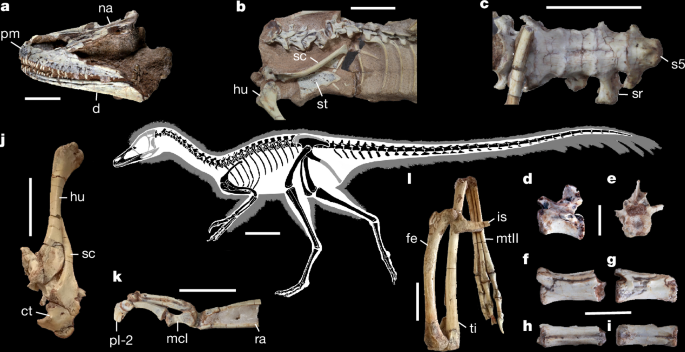
The study describes the discovery of a remarkably complete fossil of the small theropod dinosaur Alnashetri cerropoliciensis from the Late Cretaceous of Argentina. This new specimen provides crucial information about the anatomy, evolutionary relationships, and biogeographic history of the enigmatic dinosaur clade Alvarezsauroidea.
Problem & Context
Alvarezsauroids are a group of predominantly small theropod dinosaurs known mainly from the Jurassic to Cretaceous periods of Asia and South America. They possess highly specialized forelimbs adapted for digging and are interpreted as having a specialized diet of eating insects and other small prey. However, their evolutionary history and relationships have been unclear, with South American taxa traditionally viewed as a paraphyletic grade.
Methodology
The researchers analyzed the new Alnashetri specimen, along with incorporating previously known alvarezsauroid specimens into a comprehensive phylogenetic analysis. They also conducted biogeographic analyses to infer the evolutionary history and dispersal patterns of the clade.
Data & Experimental Setup
The key data sources are:
- The remarkably complete skeleton of Alnashetri cerropoliciensis (specimen MPCA Pv 377)
- Previously known alvarezsauroid specimens from Asia and South America
- Phylogenetic character data coded for a broad sample of alvarezsauroid and outgroup theropod taxa
- Biogeographic data on the geographic distributions of alvarezsauroid taxa through time
The phylogenetic analyses used the TNT software package, while the biogeographic analyses employed S-DEC, S-DIVA, and BioGeoBEARS methods.
Results
The phylogenetic analysis recovers Alnashetri as an early-branching non-parvicursorine alvarezsauroid, rendering South American alvarezsauroids polyphyletic rather than a paraphyletic grade. This suggests a Pangaean ancestral distribution for Alvarezsauroidea, with vicariance playing a major role in their early evolutionary history.
The biogeographic analyses indicate that alvarezsauroids likely originated in Pangaea and later dispersed across the Turgai Strait to North America and Asia. Dispersal between South America and the Laurasian continents was likely limited after the Albian.
Examination of the Alnashetri skeleton also revises previous models of body size evolution in alvarezsauroids. Rather than a trend toward miniaturization, the authors find evidence for repeated evolution of small body sizes within a relatively narrow overall size range.
Interpretation
The discovery of Alnashetri and its phylogenetic placement challenges the traditional view of South American alvarezsauroids as a paraphyletic grade. Instead, it suggests a more complex biogeographic history involving both vicariance and limited dispersal between Gondwana and Laurasia.
The authors interpret the lack of support for evolutionary miniaturization as an important revision to our understanding of alvarezsauroid evolution. The maintenance of a relatively narrow body size range, with repeated evolution of small sizes, suggests selective pressures favoring a particular size optimum rather than a directional trend.
Limitations & Uncertainties
- While the Alnashetri specimen is remarkably complete, other South American alvarezsauroid taxa remain fragmentary, limiting the ability to fully resolve their relationships.
- There is some uncertainty in the precise timing of dispersal events between South America and the Laurasian landmasses, as the fossil record is incomplete.
- The macroevolutionary analyses of body size evolution, while providing important insights, are limited by the relatively small sample size of alvarezsauroid species with known body size data.
What Comes Next
The authors suggest that further discoveries of more complete alvarezsauroid specimens, particularly from South America, will be crucial to refining our understanding of their evolutionary history. Integrating the growing body of data on the anatomy, phylogenetics, and biogeography of this enigmatic clade will continue to yield important insights into the pattern and processes of theropod dinosaur evolution.
Sources: