Story
Triple-junction solar cells with improved carrier and photon management
Key takeaway
Researchers made solar cells more efficient by improving how they capture and manage light and electrical charges. This could lead to cheaper, more accessible solar power for homes and businesses.
Quick Explainer
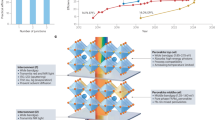
The core innovation in these triple-junction solar cells is a combination of techniques to enhance performance at both the top and middle subcell levels. A non-volatile additive improves the open-circuit voltage and stability of the wide-bandgap perovskite top cell, while a specialized three-step deposition process yields high-quality, low-bandgap perovskite middle cells with enhanced charge extraction. Additionally, integrating low-refractive-index nanoparticles in the silicon bottom cell acts as an optical reflector to boost light absorption in the middle subcell. Collectively, these advances allow the researchers to achieve a certified efficiency of 30.02% in 1 cm² triple-junction devices, a notable improvement over previous perovskite-perovskite-silicon tandem architectures.
Deep Dive
Technical Deep Dive: Triple-Junction Solar Cells with Improved Carrier and Photon Management
Overview
- This work presents advances in perovskite-silicon triple-junction solar cells, which offer higher efficiency than dual-junction devices but require addressing key performance bottlenecks.
- The key innovations are:
- A non-volatile additive that enhances the open-circuit voltage and stability of the wide-bandgap perovskite top cell.
- A three-step deposition strategy to form thick, low-bandgap perovskite middle cells with superior microstructure and charge extraction.
- Integration of low-refractive-index SiO₂ nanoparticles in the textured silicon bottom cell to improve optical absorption in the middle cell.
- These advancements combine to achieve a certified efficiency of 30.02% in 1 cm² perovskite-perovskite-silicon triple-junction devices.
Problem & Context
- Perovskite-silicon tandem solar cells offer efficiency gains over single-junction silicon, but adding a third perovskite subcell further boosts the theoretical efficiency limit.
- However, perovskite-perovskite-silicon triple-junctions face two key challenges:
- Lower open-circuit voltage (Voc) in the wide-bandgap perovskite top cell due to non-radiative recombination.
- Limited photocurrent generation in the middle perovskite subcell.
Methodology
- To address the Voc issue in the top cell:
- Investigated the use of a non-volatile additive, 4-hydroxybenzylamine, to regulate perovskite crystallization and passivate defects.
- Optimized energy-level alignment at interfaces to further improve Voc.
- To overcome the photocurrent limitation in the middle cell:
- Developed a three-step deposition process to grow thick, low-bandgap perovskite films while preserving microstructural integrity.
- Integrated low-refractive-index SiO₂ nanoparticles in the front valleys of the textured silicon bottom cell to act as an optical middle-reflector, enhancing light absorption in the middle cell.
Results
- The 4-hydroxybenzylamine additive enabled wide-bandgap perovskite top cells with Voc up to 1.405 V, a significant improvement over previous reports.
- The three-step middle cell deposition process yielded thick, high-quality perovskite layers with enhanced electron extraction.
- The SiO₂ nanoparticle optical middle-reflector improved current generation in the middle subcell.
- Combining these innovations, the authors fabricated 1 cm² perovskite-perovskite-silicon triple-junction solar cells with a certified efficiency of 30.02%.
Interpretation
- The enhancements to the top and middle subcells address two key bottlenecks in perovskite-perovskite-silicon triple-junctions.
- The additive-enabled wide-bandgap perovskite and the three-step middle cell deposition represent important advances in perovskite materials and processing.
- The optical middle-reflector is a creative approach to improving light management in the multilayer device structure.
Limitations & Uncertainties
- The source does not provide detailed performance metrics (e.g. Jsc, FF) for the individual subcells or the full device.
- The long-term stability of the devices is not assessed beyond the perovskite top cell.
- The generalizability of the materials and processing strategies to other perovskite compositions or tandem architectures is not discussed.
What Comes Next
- Further optimization of the perovskite compositions, interfaces, and device structures to push triple-junction efficiencies higher.
- Investigation of the scalability and reliability of the reported approaches for manufacturing-scale implementation.
- Exploration of additional light management techniques to enhance photon absorption and utilization across the triple-junction.
Sources: