Story
Planar Li deposition and dissolution enable practical anode-free pouch cells
Key takeaway
Planar lithium metal deposition could enable practical anode-free batteries, which would be lighter and have higher energy density than current lithium-ion batteries.
Quick Explainer
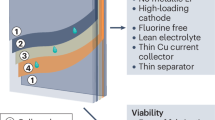
The key innovation in this work is a crossover-coupled electrolyte that generates a flexible, homogeneous, and ion-conductive solid electrolyte interphase (SEI) on the lithium metal surface. This SEI enables uniform, planar lithium deposition and dissolution, addressing the inherent structural instability of host-free lithium metal electrodes. The self-adaptive mesh-film structure of the SEI accommodates large volume changes during cycling, enabling practical implementation of high-energy-density, long-lifespan anode-free lithium metal batteries.
Deep Dive
Technical Deep Dive: Planar Li Deposition and Dissolution for Practical Anode-Free Pouch Cells
Overview
This work presents a practical anode-free lithium metal battery (AFLMB) that achieves a high energy density of 508 Wh/kg and 1668 Wh/L with a long lifespan. The key innovations are:
- A crossover-coupled electrolyte that generates a flexible, homogeneous, and ion-conductive solid electrolyte interphase (SEI) on the lithium metal surface
- This SEI enables uniform, planar lithium deposition and dissolution at high areal capacities of up to 5.6 mAh/cm2
Problem & Context
- Anode-free lithium metal batteries (AFLMBs) offer high energy density but suffer from rapid capacity fading due to the lack of an anode host and excess lithium
- The primary challenge is uneven lithium deposition/dissolution caused by the heterogeneity and fragility of the SEI layer
Methodology
- Developed a crossover-coupled electrolyte that triggers interfacial reactions to generate a B-F-based polymer-rich SEI
- This SEI exhibits sub-nanometer homogeneity, high flexibility, and rapid Li-ion transport
- The SEI spontaneously develops a self-adaptive mesh-film structure that enables uniform ion flux and accommodates large volume changes
Results
- The 2.7 Ah AFLMB cell achieved an energy density of 508 Wh/kg and 1668 Wh/L
- Demonstrated stable cycling performance of over 500 cycles at 96% capacity retention
- The uniform, planar lithium deposition/dissolution enabled high areal capacities up to 5.6 mAh/cm2
Interpretation
- The crossover-coupled electrolyte and self-adaptive SEI structure address the inherent structural instability of host-free lithium metal electrodes
- This enables practical implementation of high-energy-density, long-lifespan anode-free lithium metal batteries
Limitations & Uncertainties
- The source does not provide details on the specific electrolyte composition or composition of the SEI layer
- Long-term durability and performance under various operating conditions were not extensively evaluated
What Comes Next
- Further optimize the electrolyte and SEI composition to enhance energy density, safety, and cost
- Investigate the scalability and manufacturability of the anode-free pouch cell design
- Explore the application of this approach to other battery chemistries beyond lithium metal