Story
Genetic Generalized Additive Models
Key takeaway
Researchers have developed a new genetic algorithm that can automatically optimize complex predictive models, making it easier to understand how genes influence traits and health.
Quick Explainer
Genetic Generalized Additive Models (GGAMs) use a multi-objective genetic algorithm to automatically discover Generalized Additive Model (GAM) structures that balance predictive accuracy and interpretability. GAMs are a class of transparent models that decompose predictions into a sum of smooth, univariate functions. The GGAM approach encodes GAM hyperparameters as genes, and evolves models that minimize both prediction error and structural complexity. This allows GGAM to find a diverse set of Pareto-optimal models that offer different accuracy-interpretability trade-offs, without requiring manual specification of the GAM structure. By jointly optimizing for performance and simplicity, GGAM can identify GAMs that maintain strong predictive power while remaining sparse, smooth, and informative.
Deep Dive
Technical Deep Dive: Genetic Generalized Additive Models
Overview
This paper proposes using the multi-objective genetic algorithm NSGA-II to automatically optimize the structure and hyperparameters of Generalized Additive Models (GAMs), enabling the discovery of accurate yet interpretable models. GAMs are a class of transparent models that decompose predictions into a sum of smooth, univariate functions. However, manually configuring the structure of GAMs to balance predictive performance and interpretability is challenging.
Methodology
- The researchers used NSGA-II to evolve GAM structures, encoding the type of term (none, linear, spline), number of spline basis functions, smoothing parameter
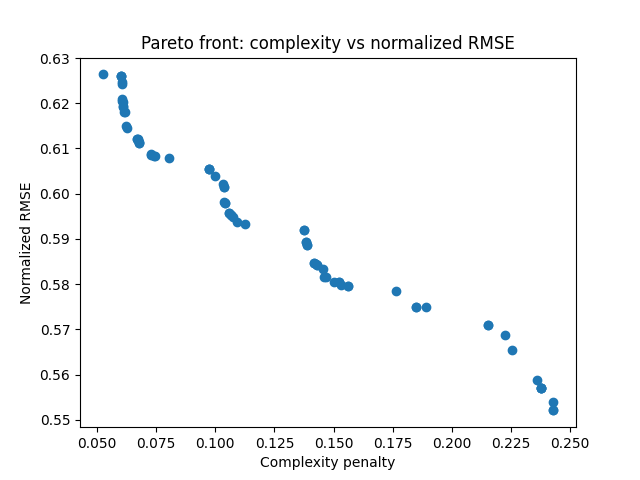
λ, and feature scaling as genes in the GA chromosomes. - NSGA-II optimized two objectives: 1) minimizing RMSE for predictive accuracy, and 2) minimizing a complexity penalty that captured model sparsity and uncertainty.
- The GA was run for 50 generations on the California Housing dataset, and three representative Pareto-optimal models were extracted: the RMSE-optimal, complexity-optimal, and knee-point solutions.
Results
- The GA-optimized GAMs consistently outperformed or matched the baseline LinearGAM and Decision Tree models in predictive accuracy, while exhibiting substantially lower complexity as measured by the penalty function.
- The RMSE-optimal GA model was simpler than the baseline LinearGAM despite achieving better predictive performance across all seeds.
- The complexity-optimal GA model remained competitive with the baselines in RMSE while attaining the lowest complexity penalty scores.
- Visualizations of the Pareto fronts demonstrated the diverse set of accuracy-complexity trade-offs discovered by NSGA-II.
- The GA-optimized GAMs produced simpler, smoother feature contributions with wider, more honest confidence intervals compared to the baseline LinearGAM.
Interpretation
- The results show that NSGA-II can effectively discover GAM structures that balance predictive accuracy and interpretability, without requiring manual specification of the model form.
- By jointly optimizing for low RMSE and low complexity, NSGA-II identifies models that achieve strong predictive performance while maintaining favorable structural properties like sparsity and smooth, informative feature contributions.
- The Pareto front of solutions provides a range of models that can be selected based on the specific needs and constraints of the application domain, rather than relying on accuracy alone.
Limitations and Uncertainties
- The paper only evaluates the proposed approach on a single dataset (California Housing), so the generalization to other problem domains is unclear.
- The computational cost of running NSGA-II was not quantified, and methods to reduce this cost (e.g., caching, memoization) were not explored.
- The study did not compare the NSGA-II-optimized GAMs to other interpretable model classes, such as fuzzy systems or rule-based models, which may exhibit different accuracy-complexity trade-offs.
Future Work
- Extend the multi-objective optimization approach to the design of fuzzy and cascading rule-based models, which share similar goals of balancing predictive performance and interpretability.
- Investigate strategies to reduce the computational cost of evaluating candidate models, such as caching or memoization, to enable large-scale multi-objective optimization of interpretable model structures.