Story
AgriWorld:A World Tools Protocol Framework for Verifiable Agricultural Reasoning with Code-Executing LLM Agents
Key takeaway
AI models can now help farmers monitor and plan agriculture more efficiently by analyzing large datasets on things like weather, soil, and crop yields. This could improve food production and sustainability, but the technology's reliability and safety must still be verified.
Quick Explainer
The AgriWorld framework bridges the gap between language models and the complex, heterogeneous data required for reliable agricultural reasoning. It consists of three key components: a Python execution environment (AgriWorld) that unifies geospatial, remote-sensing, and crop simulation tools; an Agro-Reflective agent that iterates between writing code, executing it, and refining its analysis based on feedback; and a verifiable evaluation suite (AgroBench) that enables reproducible comparisons. This execution-driven reflection is crucial for catching subtle errors in coordinate systems, aggregation windows, and unit conversions - a distinctive feature that allows the Agro-Reflective agent to outperform text-only and direct-execution baselines on complex agricultural tasks.
Deep Dive
AgriWorld: A World Tools Protocol Framework for Verifiable Agricultural Reasoning with Code-Executing LLM Agents
Overview
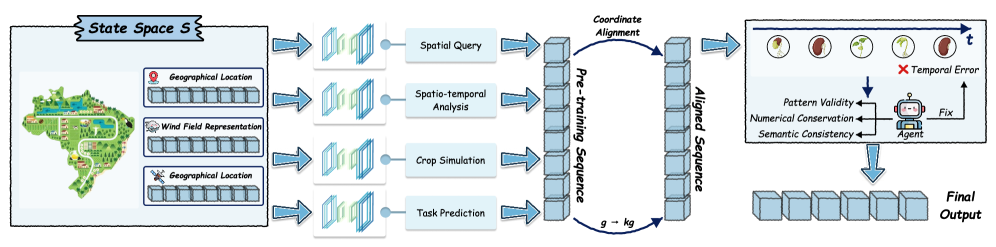
AgriWorld is a framework that bridges the gap between large language models (LLMs) and the heterogeneous, spatiotemporal data required for reliable agricultural reasoning. The key components are:
- AgriWorld: A Python execution environment that exposes APIs for geospatial queries, remote-sensing analytics, crop simulation, and task-specific predictors. It ensures data alignment, unit safety, and reproducibility through canonical operators and inspectable artifacts.
- Agro-Reflective: A multi-turn LLM agent that iterates between writing code, executing it, and refining its analysis based on execution feedback. This execution-driven reflection is crucial for catching subtle errors in coordinate systems, aggregation windows, and unit conversions.
- AgroBench: A verifiable evaluation suite with deterministic reference programs and executable checkers, enabling reproducible comparisons of agents across diverse agricultural tasks like lookups, forecasting, anomaly detection, and counterfactual interventions.
Problem & Context
Modern agronomic decision-making relies on diverse data products, including remote sensing, soil grids, field management logs, and weather streams. Answering even seemingly simple questions (e.g., "Which parcels are at risk of water stress?") requires orchestrating an ecosystem of GIS operations, time-series analytics, crop growth simulators, and task-specific models.
Large language models (LLMs) excel at natural-language interaction but cannot natively manipulate these structured datasets. Conversely, existing agricultural tools and pipelines are typically engineered for experts and lack language-facing interfaces. This mismatch leads to brittle, unverifiable responses from LLMs and prevents seamless human-AI collaboration in real-world agronomic workflows.
Methodology
The authors propose an agentic framework that follows a World-Tools-Protocol abstraction:
- World: AgriWorld, a Python execution environment that unifies geospatial querying, remote-sensing analytics, crop simulation, and task-specific predictors through consistent APIs.
- Tools: AgriWorld exposes inspectable intermediate artifacts, allowing analyses to be grounded in concrete computations and audited step-by-step.
- Protocol: A verifiable specification that transforms vague agricultural advice into executable, reproducible computational science. It checks for schema validity, numerical tolerance, counterfactual consistency, and physical sanity.
On top of this framework, the authors introduce Agro-Reflective, a multi-turn LLM agent that iterates between writing code, executing it, and refining its analysis based on execution feedback. This execution-driven reflection is crucial for catching subtle errors in coordinate systems, aggregation windows, and unit conversions.
Data & Experimental Setup
The authors evaluate their approach on AgroBench, a verifiable evaluation suite constructed from real-world agronomic workflows. AgroBench covers a broad spectrum of capabilities, including:
- Lookups (indices, phenology, resource use)
- Forecasting and monitoring
- Anomaly detection
- Counterfactual intervention analysis
AgroBench provides deterministic reference programs and executable checkers, enabling fine-grained diagnosis of failure modes (e.g., spatial misalignment, incorrect temporal windows, unit errors, ungrounded claims).
Results
The proposed Agro-Reflective agent, equipped with the World-Tools-Protocol framework, outperforms state-of-the-art text-only and direct-execution baselines on the AgroBench benchmark:
- Agro-Reflective achieves an aggregate QA score of 7.72/541 and an aggregate choice accuracy of 73.84%, establishing a new state-of-the-art.
- It significantly outperforms general-purpose giant models like GPT-4o (36.75% accuracy), demonstrating the importance of tool grounding and execution-driven reflection.
- Agro-Reflective shows the largest gains in complex multi-step reasoning tasks (e.g., Forecasting: 0.18 NRMSE vs. 0.34 for baselines; Counterfactual: 71.4% success rate vs. 43.8%).
The authors also conduct an ablation study to verify the necessity of each system component. Key findings include:
- Remote sensing tools are critical, as text-only descriptions are insufficient for calculating precise agronomic indices.
- The canonical alignment protocol is the "glue" that makes heterogeneous data usable, preventing runtime errors from spatial misalignment.
- The reflection loop allows the agent to recover from 92% of initial code generation bugs, converting potential failures into successful retrievals.
Limitations & Uncertainties
The authors note that their approach is currently limited to the agricultural domain. Extending the World-Tools-Protocol framework to other scientific domains, such as hydrology or climate science, would require developing custom execution environments and verifiable protocols.
Additionally, the current version of Agro-Reflective has a fixed budget for the execute-observe-refine loop. Future work could explore adaptive budgeting strategies or novel exploration-exploitation trade-offs to further improve efficiency.
What Comes Next
The authors highlight several promising future directions:
- Applying the World-Tools-Protocol framework to other scientific domains beyond agriculture
- Investigating more efficient exploration strategies for the execute-observe-refine loop
- Extending the verifiable protocol to support a broader range of agricultural reasoning tasks and constraints
- Exploring techniques to combine the strengths of text-based and execution-driven agents, potentially through meta-learning or hybrid architectures
Overall, the AgriWorld framework and Agro-Reflective agent demonstrate a promising path for building trustworthy, reproducible LLM agents for agricultural and other spatiotemporal scientific domains.