Story
Planar Li deposition and dissolution enable practical anode-free pouch cells
Key takeaway
Researchers developed a new battery design that can store energy without a traditional anode. This could lead to safer, lighter, and more energy-dense batteries for electric vehicles and portable electronics.
Quick Explainer
The core idea is a "crossover-coupled" electrolyte that triggers specific interfacial reactions to form a flexible, homogeneous solid electrolyte interphase (SEI) layer on the lithium metal surface. This SEI layer enables uniform and reversible planar lithium deposition and dissolution, overcoming the challenge of uneven lithium plating that has plagued anode-free lithium metal battery designs. The key is that the crossover-coupled redox-active species in the electrolyte generate this adaptive, polymer-rich SEI with high flexibility and rapid Li-ion transport, unlocking the potential for practical, high-energy-density anode-free lithium metal batteries.
Deep Dive
Technical Deep Dive: Planar Li Deposition and Dissolution for Anode-Free Pouch Cells
Overview
This work reports the development of a practical anode-free lithium metal battery (AFLMB) with high energy density and long cycle life, enabled by a novel crossover-coupled electrolyte. The key findings are:
- The crossover-coupled electrolyte triggers interfacial reactions that form a flexible, homogeneous, and ion-conductive solid electrolyte interphase (SEI) layer on the lithium metal.
- This SEI layer enables uniform and reversible planar lithium deposition/dissolution, overcoming a major challenge of uneven lithium plating in anode-free designs.
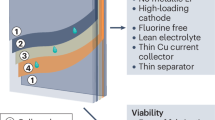
- With this advance, the researchers demonstrated a 2.7 Ah AFLMB pouch cell with an energy density of 508 Wh/kg and 1668 Wh/L, operating stably for over 500 cycles.
Problem & Context
Anode-free lithium metal batteries (AFLMBs) offer high energy density and low cost compared to traditional lithium-ion batteries. However, they have faced a critical challenge of short cycle life due to uneven lithium plating and stripping at the lithium metal electrode.
The root cause is the heterogeneous and mechanically fragile solid electrolyte interphase (SEI) that forms on the lithium metal surface. This leads to non-uniform lithium deposition and dissolution, rapid capacity fade, and potential safety issues.
Previous attempts to address this, such as using lithium metal hosts or artificial SEI layers, have had limited success in enabling practical, long-lasting AFLMBs.
Methodology
The key innovation in this work is the use of a "crossover-coupled" electrolyte that triggers specific interfacial reactions to form an adaptive, homogeneous SEI layer on the lithium metal.
The electrolyte contains a crossover-coupled pair of redox-active species. During cycling, these species undergo crossover-coupled redox reactions at both the anode and cathode interfaces. This generates a flexible, polymer-rich SEI that exhibits:
- Sub-nanometer homogeneity
- High flexibility to accommodate volume changes
- Rapid Li-ion transport
The SEI spontaneously develops a self-adaptive mesh-film structure, ensuring uniform ion flux and enabling reversible planar lithium deposition/dissolution.
Results
The researchers demonstrated a 2.7 Ah AFLMB pouch cell with:
- Energy density of 508 Wh/kg and 1668 Wh/L
- Stable operation for over 500 cycles at 96% capacity retention
Key performance metrics:
- Reversible Li plating/stripping capacity: 5.6 mAh/cm^2
- Areal capacity: 2.7 Ah
- Volumetric energy density: 1668 Wh/L
- Gravimetric energy density: 508 Wh/kg
Interpretation
The crossover-coupled electrolyte design addresses the fundamental challenge of uneven lithium deposition/dissolution in anode-free lithium metal batteries. By triggering the formation of a flexible, homogeneous SEI layer, it enables reversible planar lithium plating/stripping, unlocking the potential for high-energy-density, long-lasting AFLMBs.
This work establishes a new approach to stabilize host-free electrodes, paving the way for practical implementation of anode-free lithium metal battery technology.
Limitations & Uncertainties
The article does not provide details on:
- The specific electrolyte composition and redox-active species used
- Long-term cycling performance beyond 500 cycles
- Potential tradeoffs or limitations of the crossover-coupled approach
Further research would be needed to fully characterize the long-term stability, safety, and scalability of this AFLMB technology.
What Comes Next
This breakthrough in anode-free lithium metal battery design represents a significant step towards practical, high-energy-density energy storage. Future work could explore:
- Optimizing the crossover-coupled electrolyte composition for further performance improvements
- Investigating the long-term cycling stability and calendar life of these anode-free cells
- Scaling up the technology to larger cell formats and packs
- Assessing the safety characteristics and potential failure modes of anode-free lithium metal batteries
Overall, this work advances the field of anode-free lithium metal battery technology and demonstrates the potential for this approach to enable the next generation of high-energy, low-cost energy storage solutions.