Key takeaway
Researchers created self-contained droplets of ultracold molecules with strong magnetic properties, opening new ways to study exotic quantum materials.
Quick Explainer
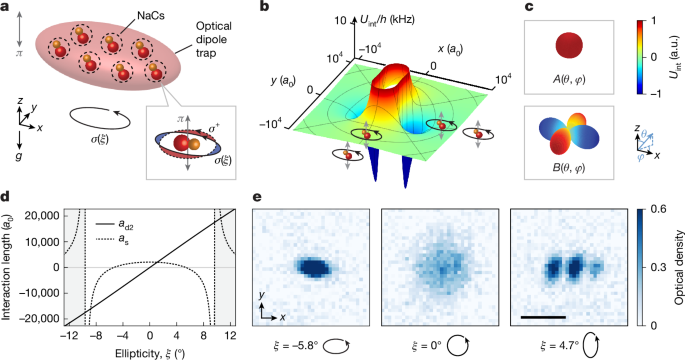
The researchers created a Bose-Einstein condensate of sodium-cesium molecules and used microwave fields to precisely control the strong dipole-dipole interactions between them. By adjusting the rate at which these interactions were induced, they were able to produce self-bound droplets and droplet arrays - dense, high-contrast regions within the gas. This demonstrates that this ultracold dipolar molecular system can serve as a versatile platform for exploring novel quantum phases of matter, such as quantum liquids and crystalline states, simply by tuning the interactions between the molecules.
Deep Dive
Technical Deep Dive: Self-Bound Droplets of Ultracold Dipolar Molecules
Overview
This work reports the formation of self-bound droplets and droplet arrays in an ultracold gas of strongly dipolar sodium–caesium (NaCs) molecules. Using microwave dressing fields, the researchers were able to induce and control the strength and anisotropy of dipole-dipole interactions in the molecular Bose-Einstein condensate. By varying the speed at which these interactions were induced, they were able to produce both equilibrium and non-equilibrium droplet structures, observing a transition from robust one-dimensional arrays to fluctuating two-dimensional droplet ensembles.
Methodology
- The researchers started with a molecular Bose-Einstein condensate of NaCs molecules.
- They used microwave dressing fields to induce and control the dipole-dipole interactions between the molecules.
- By varying the ramp rate of the microwave dressing, they were able to produce droplets under both equilibrium and non-equilibrium conditions.
Results
- The droplets showed densities up to 100 times higher than the initial Bose-Einstein condensate, reaching the strongly interacting regime.
- At slow ramp rates, the researchers observed the formation of robust, one-dimensional droplet arrays.
- At faster ramp rates, they observed a transition to fluctuating, two-dimensional droplet structures.
- The droplets suggest the possibility of a quantum-liquid or crystalline state.
Interpretation
- The observation of self-bound droplets in this ultracold dipolar molecular gas establishes it as a promising platform for the exploration of strongly dipolar quantum matter.
- The ability to tune the dipole-dipole interactions through microwave dressing opens the door to the realization of self-organized crystal phases and dipolar spin liquids in optical lattices.
Limitations & Uncertainties
- The source text does not provide information on the specific numbers, densities, or other quantitative details of the observed droplets beyond the fact that they reached densities 100 times higher than the initial Bose-Einstein condensate.
- The exact nature of the quantum-liquid or crystalline state suggested by the droplets is not fully characterized.
What Comes Next
- Further exploration of the properties and phase diagram of this self-bound dipolar molecular system, including the investigation of quantum-liquid or crystalline states.
- Potential realization of self-organized crystal phases and dipolar spin liquids in optical lattices using this platform.