Story
A High-Level Survey of Optical Remote Sensing
Key takeaway
Advances in computer vision and drones have improved optical remote sensing, giving organizations new ways to monitor the planet from the air. This could lead to better understanding of environmental changes and new applications for drone technology.
Quick Explainer
Optical remote sensing (ORS) is a crucial component of Earth observation, leveraging ubiquitous RGB sensors on satellites and drones. The survey categorizes ORS tasks into classification, object detection, segmentation, change detection, and vision-language applications. It identifies emerging trends, such as the rise of foundation models that enable multi-modal and multi-task learning. The analysis reveals architectural preferences shaped by data and task requirements, with hybrid CNN-Transformer designs offering a balanced solution. While foundation models show promise, the survey highlights the need to bridge their performance gap with fully supervised task-specific models, as well as to explore new application domains and improve robustness.
Deep Dive
Technical Deep Dive: A High-Level Survey of Optical Remote Sensing
Overview
This work provides a comprehensive overview of optical remote sensing (ORS) capabilities, covering the main task categories, available datasets, and emerging trends in the field. The key highlights are:
- ORS is a core component of Earth observation, leveraging affordable and ubiquitous RGB sensors on satellites and drones.
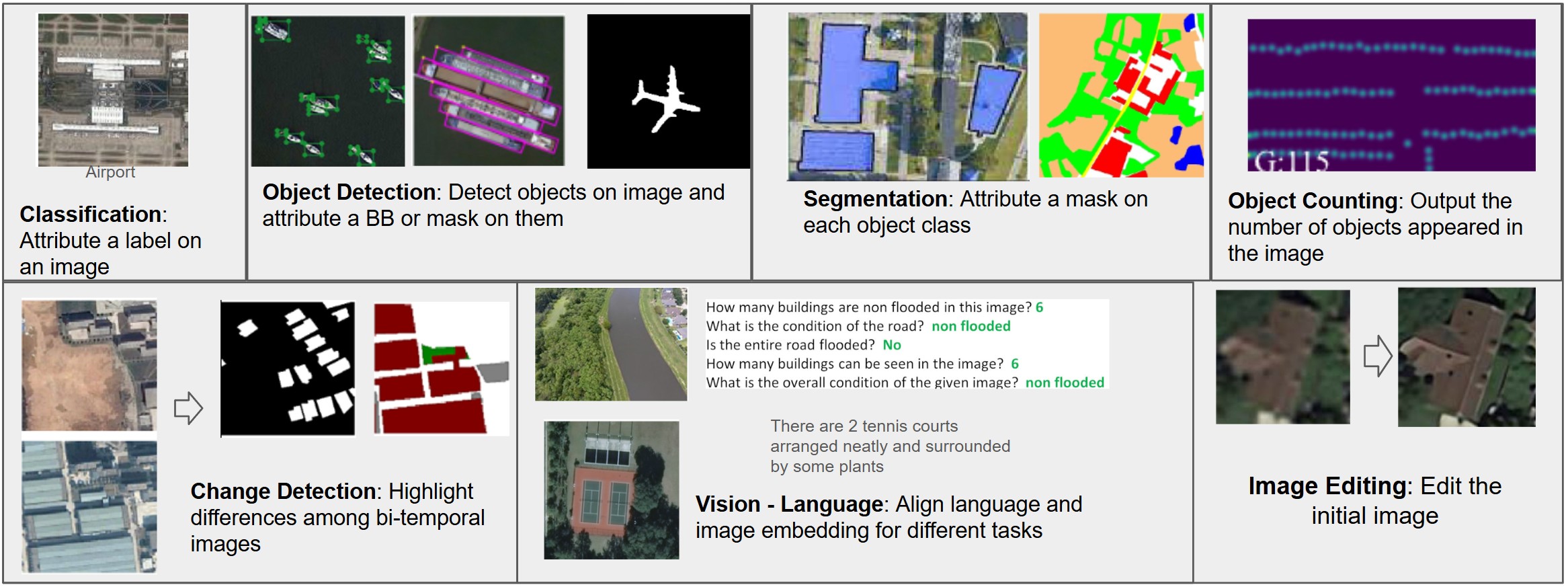
- The paper categorizes the main ORS tasks into classification, object detection, segmentation, change detection, vision-language, and image/video editing.
- It analyzes the most popular datasets for each task, discussing their characteristics and use cases.
- The survey identifies the emergence of foundation models as a key trend, enabling multi-modal and multi-task learning.
- Insights drawn from the state-of-the-art analysis reveal architectural preferences shaped by data and task requirements, favoring hybrid CNN-Transformer designs.
- Open research gaps include improving foundation model performance, efficiency, robustness, and expanding to new application domains.
Problem & Context
Earth observation (EO) is the collection and analysis of data about Earth, acquired by various sensors and cameras. ORS is a core component of EO, focusing on RGB imagery from satellites and drones. The widespread adoption of affordable and reliable drones has further strengthened the prevalence of RGB sensors in remote sensing.
Significant advances in computer vision, image processing, and communication networks have amplified the utility of RGB-based ORS. However, most existing surveys focus on specific tasks or application domains, lacking a comprehensive overview of the field's capabilities.
This work aims to provide a modality-centric perspective, offering a unified review of RGB-based ORS tasks, datasets, and emerging trends. By jointly examining tasks, benchmarks, and recent foundation models, the survey serves as a practical entry point for researchers working with the most widely available EO imagery.
Methodology
The authors conducted a literature search using the Elsevier Scopus and IEEE Xplore databases, focusing on the top 20 remote sensing venues and popular AI/Computer Vision venues from the last 4 years (2022-2025).
The selection of articles was based on criteria such as citations, authors, and task diversification, ensuring a comprehensive coverage of the field.
Data & Experimental Setup
The paper provides detailed overviews of the most popular ORS datasets, categorized by task:
- Classification: Datasets such as UCM, AID, and NWPU-RESISC45, containing images from construction and nature domains.
- Object Detection: Horizontal (NWPU VHR-10, LEVIR, DIOR), oriented (DOTA-v1, DOTA-v2, FAIR1M), and salient (ORSSD, EORSSD) object detection datasets.
- Segmentation: Semantic (Inria, WHU-Building, LoveDA) and instance (iSAID) segmentation datasets.
- Change Detection: Binary (CDD, WHU-CD, LEVIR-CD) and semantic (Second, Landsat-SCD) change detection datasets.
- Vision-Language: Image captioning (RS5M), visual grounding (DIOR-RSVG), and change detection VQA (CDVQA) datasets.
The datasets are described in terms of size, domain, number of classes, number of instances, spatial resolution, and source (satellite or UAV).
Results
The survey identifies the following key results and trends in the ORS field:
- Task-Specific Architectural Preferences:
- CNNs excel in tasks dominated by local patterns, such as homogeneous image classification, small-object detection, and object counting.
- Transformer-based models outperform in tasks requiring global context modeling, including complex object detection, segmentation, and vision-language alignment.
- Hybrid CNN-Transformer architectures emerge as a balanced solution, achieving strong performance across diverse datasets and tasks.
- Emergence of Foundation Models:
- Foundation models (FMs) trained on large-scale, self-supervised datasets are a clear emerging trend in ORS.
- FMs like SMLFR, RingMo, and RemoteCLIP demonstrate capabilities across multiple ORS tasks, indicating the potential for a single generalizable model.
- However, FMs are not yet competitive with fully supervised training on task-specific datasets, presenting an open challenge.
- Open Research Gaps:
- Bridging the performance gap between FMs and task-specific models.
- Developing efficient diffusion models for video and exploring oriented object tracking.
- Reviving salient object detection, improving small-object detection, and extending Mamba-based models.
- Exploring emerging directions like semantic change detection, learning with limited annotations, and multi-class object counting.
Interpretation
The survey highlights the field's maturity, with a wide range of tasks, datasets, and architectural trends. The task-specific insights reveal the importance of selecting models based on data characteristics and efficiency constraints, rather than seeking a single universally superior architecture.
The emergence of foundation models is a significant trend, indicating a shift toward scalable, generalizable, and multi-modal solutions. However, the performance gap between FMs and task-specific models remains an open challenge that requires further research.
The identified open research areas reflect the need for continuous innovation to address the diverse requirements of real-world ORS applications, including robustness, efficiency, and expanding to new domains.
Limitations & Uncertainties
The survey is limited to the reviewed literature, which may not capture the full breadth of work in the rapidly evolving ORS field. Additionally, the analysis is primarily based on quantitative metrics reported in the papers, which may not fully reflect practical considerations and real-world performance.
The open research gaps identified are largely based on the authors' interpretation of the current state-of-the-art and may not represent a comprehensive list of all outstanding challenges in the field.
What Comes Next
Future progress in ORS will likely depend on the continued development of scalable, generalizable, and efficient learning frameworks, particularly in the context of foundation models. Addressing the performance gap between FMs and task-specific models, as well as exploring new application domains and data modalities, will be key areas of focus.
Additionally, the field may see increased attention on improving the robustness and adversarial resilience of ORS systems, as well as leveraging emerging techniques like diffusion models and graph neural networks to enhance specific task capabilities.