Key takeaway
Improved climate models now show well-mixed greenhouse gases trap more heat than previously thought, suggesting we need deeper emissions cuts to avoid dangerous warming.
Quick Explainer
This study presents a novel approach to quantifying the longwave radiative forcing of well-mixed greenhouse gases, which is a key driver of Earth's energy imbalance and climate change. The core idea is to leverage the robust linear relationship between observed outgoing longwave radiation and the instantaneous radiative forcing at the tropopause. By applying a regression model to satellite measurements, the approach provides an efficient way to estimate radiative forcing that is observationally constrained, while avoiding the computational complexity of detailed line-by-line radiative transfer calculations. This simple yet powerful framework enables consistent benchmarking of radiative transfer parameterizations across climate models, ultimately reducing persistent uncertainties in greenhouse gas forcing and strengthening confidence in long-term climate projections.
Deep Dive
Overview
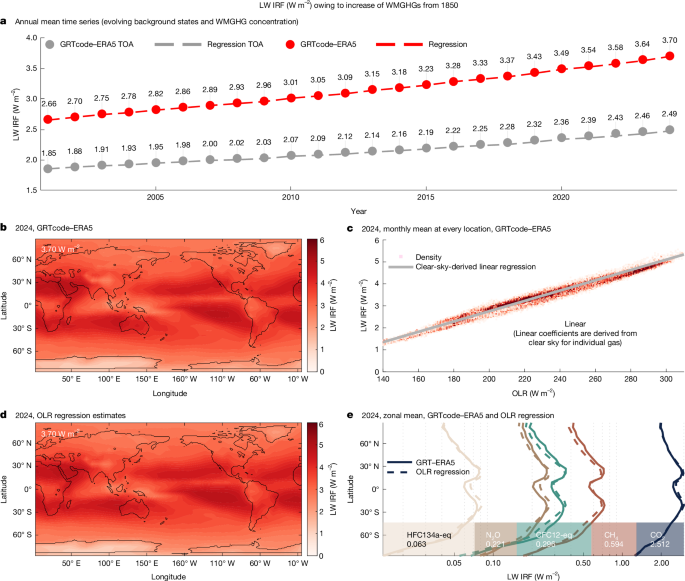
This study establishes the first global benchmark for the longwave (LW) instantaneous radiative forcing (IRF) of well-mixed greenhouse gases (WMGHGs) under realistic, all-sky conditions. Using a spectrally resolved, highly parallelized line-by-line radiative transfer model, the authors quantify a post-1850 LW IRF (at the tropopause) of 3.69 ± 0.07 W m^-2 (95% confidence interval) by 2024, with 38% of this increase occurring since 2001.
The study demonstrates that LW IRF at the tropopause is a dominant source of inter-model spread in CO2-induced effective radiative forcing (ERF) across Earth system models. It introduces a regression-based method that integrates observational constraints from satellite-observed outgoing longwave radiation (OLR) to accurately estimate LW IRF, providing a practical alternative to computationally intensive line-by-line diagnostics for benchmarking radiative forcing in models.
Problem & Context
- Radiative forcing from well-mixed greenhouse gases (WMGHGs) is a main driver of Earth's energy imbalance and global surface climate change.
- However, it remains difficult to constrain, largely because its longwave (LW) instantaneous radiative forcing (IRF) component depends on atmospheric state and is subject to radiative parameterization error.
- The IRF measures the immediate change in radiative fluxes at the tropopause caused by perturbations in WMGHG concentrations.
- Despite advances in spectroscopy, satellite observations and radiative modelling, the state dependence of LW IRF remains a leading source of uncertainty in the radiative forcing of greenhouse gases.
Methodology
- The study uses the GPU-optimized line-by-line radiative transfer code (GRTcode) developed at NOAA's Geophysical Fluid Dynamics Laboratory to conduct global-scale, decadal line-by-line calculations of LW radiative forcing for CO2, CH4, N2O, CFCs and HFCs.
- The calculations use monthly mean atmospheric fields from the ERA5 reanalysis dataset and WMGHG concentrations following the CMIP7 input datasets.
- The authors construct a simple regression model relating LW IRF to outgoing longwave radiation (OLR) under clear-sky conditions.
- This regression model is then applied to all-sky OLR to obtain observationally constrained estimates of LW IRF.
Results
- The GRTcode–ERA5 simulations show that the LW IRF increased from 2.66 to 3.70 W m^-2 at the tropopause and from 1.85 to 2.49 W m^-2 at the top-of-atmosphere (TOA) between 2001 and 2024.
- The regression-based method accurately reproduces the spatial patterns and global mean values of LW IRF under both clear-sky and all-sky conditions.
- When applied to CERES satellite observations of OLR, the regression method yields an observationally constrained increase in LW IRF from 2.65 to 3.69 W m^-2 over the 2001-2024 period.
- The authors find that LW IRF at the tropopause explains 91% of the inter-model spread in ERF for CO2 across Earth system models.
Interpretation
- The robust linear relationship between OLR and LW IRF provides a simple and efficient framework for benchmarking radiative forcing under diverse atmospheric conditions in Earth system models.
- Applying the regression method to model-simulated OLR reveals that most discrepancies in LW IRF originate from radiation parameterizations, and correcting these biases would reduce uncertainty in CO2 ERF by 50%.
- The study establishes a scalable pathway to reducing persistent uncertainties in greenhouse gas forcing by linking physically robust line-by-line calculations with observational constraints.
Limitations & Uncertainties
- Simulating cloud radiative effects in line-by-line models remains sensitive to assumptions about subcolumn cloud inhomogeneity, vertical cloud overlap and hydrometeor particle sizes, leading to biases and uncertainties that are challenging to quantify.
- The long-term instrumental stability of the OLR record is not explicitly considered, and further drift in the IRF associated with OLR drift can be incorporated by scaling it through the regression slope.
- Extrapolation of the regression method beyond the historical to near-future range used in this study may introduce additional bias and uncertainty.
What Comes Next
- Community-wide use of the OLR–regression method, together with double-call diagnostics applied systematically to each main WMGHG, would enable consistent benchmarking of radiative transfer parameterizations in Earth system models.
- This would strengthen confidence in climate assessments and long-term climate projections by reducing the persistent uncertainties in greenhouse gas forcing.
- Continued efforts to maintain stable, long-term observational records of energy fluxes are crucial for achieving tight constraints on radiative forcing in the future.