Story
Dataless Weight Disentanglement in Task Arithmetic via Kronecker-Factored Approximate Curvature
Key takeaway
Researchers developed a technique to adapt AI models to new tasks while preventing performance declines, a key step towards more flexible and capable AI systems.
Quick Explainer
The researchers propose a dataless regularization technique called TAK that aims to improve the performance of Task Arithmetic (TA), a modular approach for adapting foundation models. TAK leverages Kronecker-Factored Approximate Curvature (KFAC) to encourage weight disentanglement between task-specific parameter updates, mitigating cross-task interference that can arise when composing multiple task vectors. The KFAC-based approximation enables efficient, constant-complexity regularization, making the approach practical for real-world applications with many tasks, without requiring access to external task data. This dataless regularization strategy is a distinctive feature of TAK compared to existing representation drift control methods.
Deep Dive
Technical Deep Dive: Dataless Weight Disentanglement in Task Arithmetic via Kronecker-Factored Approximate Curvature
Overview
This work addresses the problem of cross-task interference when composing multiple task vectors in Task Arithmetic (TA), a modular approach for adapting foundation models. The authors propose a dataless regularization technique called TAK that leverages Kronecker-Factored Approximate Curvature (KFAC) to encourage weight disentanglement and improve the performance of TA.
Problem & Context
- Task Arithmetic (TA) enables adapting foundation models by combining task-specific parameter updates (task vectors), but this can lead to cross-task interference and representation drift.
- Existing representation drift regularization approaches require access to external task data, which conflicts with modularity and data availability constraints.
Methodology
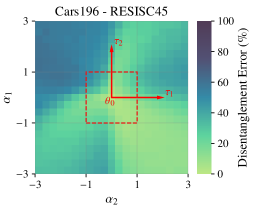
- The authors derive a dataless regularization objective by connecting representation drift to the Jacobian's Gram matrix, which can be approximated using the Generalized Gauss-Newton (GGN) matrix.
- They adopt the Kronecker-Factored Approximate Curvature (KFAC) method to efficiently approximate the GGN, enabling constant-complexity regularization regardless of the number of tasks.
- They propose an aggregation scheme to merge per-task curvature factors into a single surrogate, further improving efficiency.
Data & Experimental Setup
- Experiments are conducted on the 8 Vision benchmark, using CLIP as the foundational vision backbone.
- The authors evaluate both the linearized fine-tuning regime (as per Ortiz-Jimenez et al., 2023) and the standard non-linear fine-tuning.
- They compare their TAK method to baselines like linear fine-tuning, representation drift regularization (Yoshida et al., 2025), and diagonal GGN (Porrello et al., 2025).
Results
- In the linearized fine-tuning regime, TAK achieves state-of-the-art performance, outperforming baselines on both absolute and normalized accuracy metrics.
- TAK also exhibits desirable properties like task localization (distinct task vectors govern separate regions in function space) and robustness to task vector rescaling.
- In the non-linear fine-tuning regime, TAK significantly outperforms standard fine-tuning and attention-only fine-tuning (Jin et al., 2025).
Interpretation
- The authors' dataless regularization approach successfully addresses the cross-task interference problem in TA, enabling effective composition of task vectors without requiring access to external task data.
- The KFAC-based approximation provides an efficient and scalable solution, making the regularization practical for real-world applications with many tasks.
Limitations & Uncertainties
- The work is based on a preprint and has not yet been peer-reviewed or published.
- The experiments are limited to the 8 Vision benchmark and CLIP model. Broader evaluation across different domains and architectures would help validate the generalization of the proposed method.
- The authors do not discuss the computational overhead or runtime impact of their KFAC-based regularization, which could be an important practical consideration.
What Comes Next
- Further research could explore extending the dataless regularization approach to other types of foundation models beyond computer vision, such as language models or multimodal models.
- Investigating the interplay between the proposed regularization and other TA techniques, like fine-tuning order or task vector normalization, could yield additional insights.
- Exploring the role of the KFAC approximation quality and its impact on weight disentanglement and TA performance would be an interesting direction.
Sources: