Story
Transforming Behavioral Neuroscience Discovery with In-Context Learning and AI-Enhanced Tensor Methods
Key takeaway
AI tools are helping scientists analyze and interpret complex neuroscience data faster, potentially leading to new discoveries about how the brain works and behavior.
Quick Explainer
The core idea is to leverage AI-powered tools to accelerate the tedious data preparation and analysis tasks in behavioral neuroscience research. The pipeline first uses in-context learning to automate the annotation of mouse behaviors from videos. It then applies advanced tensor decomposition methods to extract latent patterns from the coupled neural activity and behavioral datasets. Finally, it uses language models to assist domain experts in interpreting these discovered patterns, providing a useful starting point for scientific analysis. The key novel components are the "Autoregressive ICL" technique for improved temporal behavior annotation, and the Neural Additive Tensor Decomposition (NeAT) method, which captures non-linear interactions between the data modalities more effectively than simpler tensor models.
Deep Dive
Transforming Behavioral Neuroscience Discovery with In-Context Learning and AI-Enhanced Tensor Methods
Overview
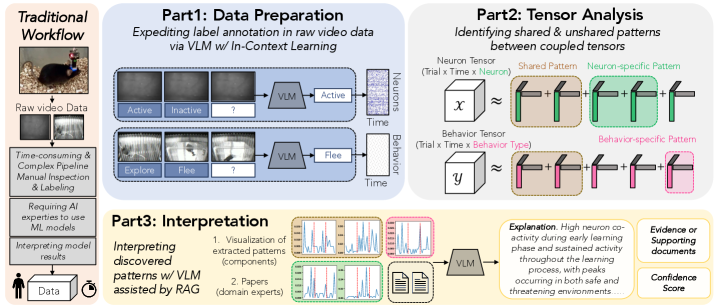
This paper presents an AI-enhanced pipeline for accelerating discovery in behavioral neuroscience research, with a focus on understanding fear discrimination and generalization in mice. The key components of the pipeline are:
- In-Context Data Preparation: Leveraging In-Context Learning (ICL) to automate tedious data preparation tasks, such as annotating mouse behaviors from videos.
- AI-Enhanced Tensor Analysis: Applying neural tensor decomposition methods to extract latent patterns from coupled neuroscience datasets (neural activity and behavioral observations).
- AI-Driven Pattern Interpretation: Using language models and retrieval-augmented generation to assist domain experts in interpreting the discovered latent patterns.
The authors demonstrate the effectiveness of this pipeline through extensive experiments and a case study on real neuroscience data, showing how it can transform a traditionally complex and manual research workflow into one that empowers domain experts to focus on scientific discovery.
Methodology
In-Context Data Preparation
- Identified ICL as a promising approach to automate data preparation tasks for domain experts without requiring extensive AI/ML expertise.
- Introduced "Autoregressive ICL" (AR-ICL) to capture temporal continuity in mouse behavior annotations, improving performance over standard ICL.
- Also explored using ICL for coarse extraction of neural activity from calcium imaging data, but found performance limited by the fine-grained nature of the signals.
AI-Enhanced Tensor Analysis
- Leveraged tensor decomposition methods, including CANDECOMP/PARAFAC decomposition (CPD) and the more advanced Neural Additive Tensor Decomposition (NeAT).
- NeAT achieves 46% lower test RMSE than CPD on the neuroscience datasets, demonstrating the benefit of its non-linear modeling capabilities.
- Coupled the neural activity and behavioral tensors to discover shared and unshared latent patterns.
AI-Driven Pattern Interpretation
- Designed a system to automatically generate plausible, literature-grounded hypotheses for the discovered latent patterns.
- Used a combination of In-Context Learning and Retrieval-Augmented Generation to leverage both visual information (factor plots) and relevant scientific literature.
- Demonstrated moderate agreement between model-generated interpretations and expert annotations, suggesting the system can serve as a useful interpretive aid.
Data & Experimental Setup
- Collected neural activity data using one-photon calcium imaging in the prelimbic region of the mouse medial prefrontal cortex during a fear conditioning and discrimination task.
- Simultaneously recorded mouse behaviors, which were manually annotated by domain experts as freezing, fleeing, or grooming/exploring.
- Datasets comprised 33 trials across 7 mice, with neural activity tensors of size (33 x 6000 x Ns) and behavior tensors of size (33 x 6000), where Ns ranged from 948 to 2339 neurons per subject.
Results
Behavioral Video Labeling
- AR-ICL achieved the best performance, with a macro F1 score of 0.545, balanced accuracy of 0.801, and MCC of 0.517.
- Outperformed a DINO-V2 baseline as well as standard ICL and a temporal context-only variant.
Tensor Decomposition
- NeAT outperformed the simpler CPD model, achieving 46% lower test RMSE on the coupled neural and behavioral tensors.
- NeAT was able to capture non-linear interactions between the data modalities more effectively.
AI-Driven Interpretation
- The language model-based interpretation system achieved moderate agreement with expert annotations, with a weighted Cohen's kappa of 0.59.
- While not as detailed as expert interpretations, the model-generated hypotheses provided a useful starting point for guiding scientific analysis.
Limitations & Uncertainties
- The ICL-based calcium imaging preprocessing approach had limited performance, suggesting the need for more sophisticated methods to handle the fine-grained and noisy neural signals.
- The interpretability of the tensor decomposition results, while enhanced by the NeAT model, is still dependent on the domain experts' ability to link the latent factors to neuroscientific concepts.
- The evaluation of the end-to-end pipeline was limited to a small dataset of two subjects, and further validation on larger-scale datasets is needed.
Future Work
The authors highlight several directions for future work:
- Investigating more advanced techniques for incorporating temporal dynamics into the ICL-based behavioral labeling.
- Exploring neural network architectures that can better capture the spatial and temporal structure of calcium imaging data.
- Expanding the AI-driven interpretation system to support more sophisticated reasoning and hypothesis generation capabilities.
- Validating the effectiveness of the full pipeline on larger-scale behavioral neuroscience datasets and across different experimental paradigms.