Key takeaway
Forests, grasslands, and alpine areas are seeing changes in their plant and animal communities as the climate warms, with potential impacts on ecosystem services like food production and tourism.
Quick Explainer
This study investigated how climate warming has impacted plant communities in different ecosystems over time. In forests and grasslands, the vegetation shifted gradually towards more warm-adapted species. However, alpine summits showed a much more pronounced shift, driven by both the arrival of warmth-loving plants and the decline of cold-adapted species. The researchers also found that forests and alpine regions accumulated significant "climatic debts", where the plants lagged behind the pace of climate change, unlike the more resilient grasslands. This divergence in thermophilization trajectories suggests that some ecosystems, like grasslands, may be better able to track climate change than others, like long-lived forests and sensitive alpine zones.
Deep Dive
Technical Deep Dive: Contrasting Thermophilization Across Ecosystems
Overview
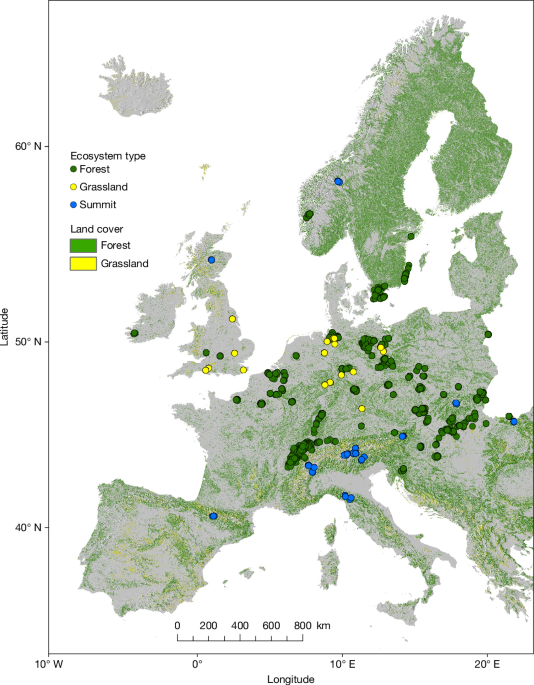
This study examined vegetation changes in response to climate warming across forests, grasslands, and alpine summits in Europe over 12-78 years. The key findings are:
- Forest understories and grasslands showed positive but non-significant thermophilization (shift towards warmer-adapted species).
- Alpine summits exhibited much stronger (up to 5x) and statistically significant thermophilization.
- Thermophilization was driven by increases in warmth-demanding species in grasslands, declines in cold-adapted species on alpine summits, and both processes in forests.
- Significant climatic debts (species lagging behind climate change) accumulated in forests and alpine summits, but less so in grasslands.
Methodology
- Analyzed data from 6,067 vegetation plots resurveyed over 12-78 years across Europe.
- Quantified thermophilization as shifts in the 5th, 50th (median), and 95th percentiles of the community-weighted mean temperature (TCWM) distribution.
- Climatic debt was calculated as the difference between observed TCWM and expected TCWM based on climate change.
- Used Bayesian mixed-effects models to estimate thermophilization rates and climatic debts, accounting for differences in plot characteristics, climate, and spatial autocorrelation.
Results
Thermophilization Patterns
- Forests and grasslands showed positive but non-significant thermophilization (0.13°C and 0.09°C per decade, respectively).
- Alpine summits exhibited much stronger thermophilization (0.46°C per decade).
- Thermophilization was driven by:
- Increases in warmth-demanding species in grasslands
- Declines in cold-adapted species on alpine summits
- Both processes in forests
Climatic Debts
- Significant climatic debts accumulated in forests (0.21°C per decade) and alpine summits (0.37°C per decade).
- Climatic debts were lower in grasslands (0.07°C per decade).
- Climatic debts were positively correlated with macroclimate temperature changes.
Mechanisms of Thermophilization
- Grasslands showed thermophilization primarily through increases in warmth-demanding species.
- Forests exhibited thermophilization via both increases in warmth-demanding species and declines in cold-adapted species.
- Alpine summits experienced thermophilization mainly through declines in cold-adapted species and shifts in species abundances.
Interpretation
- The divergent thermophilization trajectories suggest ecosystems differ in their ability to track climate change.
- Grasslands may be more resilient due to higher microclimatic buffering and shorter plant generation times.
- Forests and alpine summits are more susceptible to climatic debts, likely due to longer plant lifespans and lower microclimatic buffering.
- These findings provide a basis for projecting future shifts in plant communities under continued climate warming.
Limitations & Uncertainties
- The study did not account for potential interactions between climate change and other drivers like land use, nitrogen deposition, or biotic interactions.
- Spatial autocorrelation and climate data resolution did not significantly impact the results, but other unmeasured factors could introduce biases.
- The mechanisms underlying the divergent thermophilization patterns require further investigation.
What Comes Next
- Explore how other drivers like land use, pollution, and biotic interactions may modify the thermophilization response.
- Investigate the physiological and demographic mechanisms underpinning the differential thermophilization across ecosystems.
- Develop models to project future plant community shifts under scenarios of accelerating climate change.