Story
Local agricultural transition, crisis and migration in the Southern Andes
Key takeaway
Farmers in the Andes had to adapt or migrate when their maize-based agriculture faced crisis, revealing the vulnerability of local food systems to environmental changes.
Quick Explainer
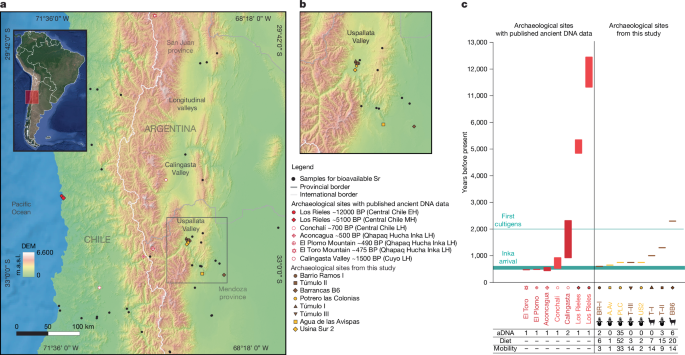
This study examines the complex history of agricultural transition in the Uspallata Valley of the southern Andes. By integrating ancient genomics, isotopic analyses, and archaeological evidence, the researchers reconstructed the interplay between local hunter-gatherer groups and migrant farming populations. The key findings include genetic continuity suggesting local agricultural adoption, fluctuating maize intake indicating flexible farming strategies, and the arrival of migrants from nearby regions shortly before the Inca expansion. The study reveals that the regional transition to agriculture was accompanied by a multidimensional crisis experienced by the migrant population, highlighting the resilience strategies employed by local groups in the face of broader socioeconomic upheaval in the southern Andes.
Deep Dive
Technical Deep Dive: Local Agricultural Transition, Crisis, and Migration in the Southern Andes
Overview
This study examines the transition to agriculture and subsequent demographic shifts in the Uspallata Valley, a southern frontier of Andean farming. Using ancient genomics, isotopic analyses, and archaeological evidence, the authors reconstruct the complex history of local hunter-gatherer groups, the arrival of migrant farmers, and the regional socioeconomic crisis that unfolded.
Problem & Context
- The transition to agriculture was a transformative process with wide-ranging demographic and social consequences across South America.
- The Uspallata Valley offers a unique opportunity to study late agricultural adoption and its impacts on local populations.
Methodology
- Analyzed 46 newly sequenced ancient human genomes to investigate genetic continuity and change between pre-farming and farming populations.
- Conducted palaeodietary isotope (δ13C/δ15N) and strontium isotope (87Sr/86Sr) analyses to assess dietary shifts and migration patterns.
- Integrated genomic, isotopic, and archaeological data to reconstruct the demographic history and lifeways of local groups and migrant populations.
Data & Experimental Setup
- Obtained 46 ancient human genomes from the Uspallata Valley and nearby regions.
- Performed stable isotope analyses (δ13C/δ15N, 87Sr/86Sr) on human remains.
- Integrated data from previous archaeological investigations in the region.
- Developed a bioavailable strontium isoscape model for the southern Andes using machine learning techniques.
Results
Genetic Continuity and Unique Population History
- Genetic analyses revealed genetic continuity between pre-farming and farming populations in the Uspallata Valley, indicating local adoption of agriculture.
- The Uspallata Valley groups carried a distinct genetic component in Indigenous American diversity, suggesting a unique population history in the region.
Dietary Shifts and Flexible Farming
- Palaeodietary isotopes showed fluctuating maize intake, consistent with flexible farming strategies among local groups.
Arrival of Migrants and Regional Crisis
- Strontium isotopes indicate the arrival of migrants from nearby regions between ~810–700 cal years BP, shortly before the Inca expansion.
- Genomic and isotopic analyses suggest these migrants belonged to the same regional metapopulation as local groups, relied heavily on maize, likely moved in matrilineally organized family groups, and experienced stress markers (malnutrition, diseases like tuberculosis).
- The migrant population exhibited a long-term demographic decline, indicating a multidimensional crisis.
Interpretation
- Local groups used social organization and migration as resilience strategies in the face of this regional crisis.
- The transition to agriculture in the Uspallata Valley was a complex process, with both genetic continuity and the arrival of migrant groups from nearby regions.
- The regional crisis experienced by the migrant population suggests broader socioeconomic upheaval in the southern Andes during this period, likely driven by environmental and/or political factors.
Limitations & Uncertainties
- The study is limited to the Uspallata Valley and nearby regions, and may not be representative of the entire southern Andes.
- The causes of the regional crisis experienced by the migrant population are not fully clear from the current evidence.
- Some details about the lifeways and social organization of the local and migrant groups are inferred from the available data and may require further investigation.
What Comes Next
- Further research is needed to understand the broader regional context and the factors driving the observed demographic and societal changes.
- Expanding the geographic scope of ancient genomic and isotopic analyses could provide a more comprehensive picture of the agricultural transition and its consequences across the southern Andes.