Story
Integrated memristor for mitigating reverse-bias in perovskite solar cells
Key takeaway
Researchers have developed a new device that helps perovskite solar cells work better in shaded conditions, improving their reliability and making them more practical for wider use.
Quick Explainer
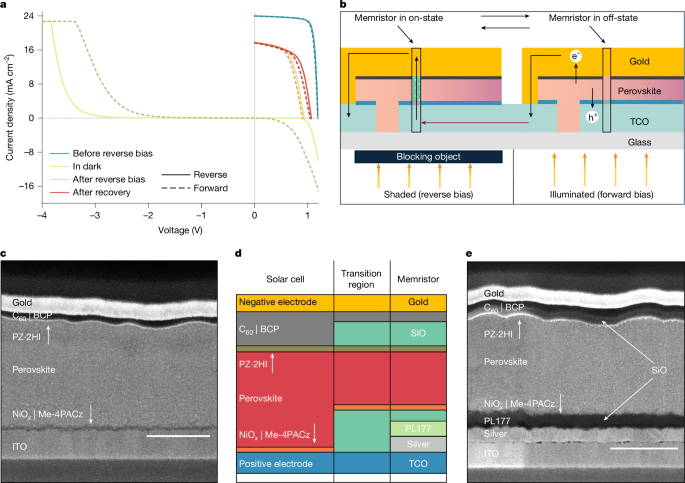
The Memsol device integrates a memristor directly into the structure of a perovskite solar cell, providing an elegant solution to the reverse bias instability issue that can occur during real-world operation. Under normal illumination, the Memsol functions as a high-efficiency solar cell. However, when exposed to reverse bias or partial shading, the memristor automatically transitions to a low-resistance bypass state, protecting the solar cell and allowing it to continue generating power. This self-regulating bypass mechanism eliminates the need for external bypass diodes, a key advantage that could accelerate the widespread adoption of perovskite solar technology.
Deep Dive
Technical Deep Dive: Integrated Memristor for Mitigating Reverse-Bias in Perovskite Solar Cells
Overview
Perovskite solar cells (PSCs) have achieved power conversion efficiencies comparable to established photovoltaic technologies, and offer advantages like low-cost and energy-efficient fabrication. However, PSCs suffer from instability under moderate reverse bias, which can occur during real-world operation due to partial shading or series connections.
This study presents a novel "Memsol" device - a solar cell with an integrated memristor that protects the solar cell and acts as a bypass element. The memristor operates in a low-resistance bypass state under reverse bias or shading, and transitions to a high-efficiency solar cell mode under normal illumination.
Methodology
The Memsol device incorporates an additional metal-insulator stack deposited selectively to form the memristor component, which shares the perovskite absorber and electrodes with the solar cell. Reverse bias and shading tests were performed to evaluate the Memsol's stability and bypass behavior.
Results
- The Memsol remained stable under reverse bias and shading, automatically switching between a low-resistance bypass state and high-efficiency solar cell operation.
- A Memsol device exhibited a power conversion efficiency of 22.5%, with a Voc of 1.205 V, Jsc of 23.3 mA/cm², and FF of 0.80.
- The off-state resistance of the memristor was 7 orders of magnitude lower than the solar cell's shunt resistance, indicating negligible power loss.
- Cycling tests showed the Memsol could withstand over 24 cycles of 1 hour reverse bias followed by 20 seconds of illumination, with minimal degradation.
- Thermal stability tests at 65°C showed the Memsol retained over 90% of its initial efficiency after 1000 hours.
- A 9-cell Memsol mini-module demonstrated the ability to automatically bypass a shaded cell.
Interpretation
The Memsol integrates a memristor directly into the solar cell structure, providing an elegant solution to the reverse bias instability issue in PSCs. The memristor acts as a self-regulating bypass element, automatically protecting the solar cell under unfavorable conditions without the need for external circuitry.
This approach could enable the widespread adoption of PSCs in large-scale photovoltaic modules by eliminating the need for bypass diodes, which are typically required to handle reverse bias and partial shading. The thermal and cycling stability demonstrated suggest the Memsol is a promising technology for practical deployment.
Limitations & Uncertainties
- The study only reports results for a single Memsol device, so the performance variability and reliability across a larger sample size is unclear.
- The long-term degradation mechanisms of the Memsol under real-world operating conditions are not yet fully understood.
- The ability to fabricate the Memsol at scale with consistent quality and performance is not demonstrated.
What Comes Next
The authors anticipate the Memsol concept will be implemented in large-scale photovoltaic modules, potentially making external bypass diodes unnecessary and accelerating the commercialization of perovskite solar technology.
Further research is needed to:
- Evaluate the Memsol's performance and reliability across a statistically significant number of devices
- Investigate the long-term degradation mechanisms and improve the thermal and operational stability
- Demonstrate scalable manufacturing processes for consistent, high-quality Memsol production
Sources: [1] Mohammadi, M. et al. Integrated memristor for mitigating reverse-bias in perovskite solar cells. Nature (2026). https://doi.org/10.1038/s41586-026-10275-3