Story
Broadly stable atmospheric CO<sub>2</sub> and CH<sub>4</sub> levels over the past 3 million years
Key takeaway
Ancient Antarctic ice reveals that Earth's two main greenhouse gases, carbon dioxide and methane, have remained remarkably stable for millions of years - an important finding for understanding past climate patterns and future emissions targets.
Quick Explainer
This study provides a long-term perspective on atmospheric greenhouse gas levels over the past 3 million years. By analyzing gas concentrations in ancient Antarctic ice cores, the researchers pieced together a record showing that carbon dioxide and methane levels were broadly stable during this time period, with only minor fluctuations. This contrasts with the large glacial-interglacial swings seen in more recent periods, suggesting the climate system was less sensitive to orbital drivers before the mid-Pleistocene. The stable greenhouse gas concentrations offer new insights into the carbon cycle's behavior over geological timescales, setting the stage for further investigations that integrate these findings with climate models and other paleoclimate data.
Deep Dive
Technical Deep Dive: Broadly Stable Atmospheric CO2 and CH4 Levels Over the Past 3 Million Years
Overview
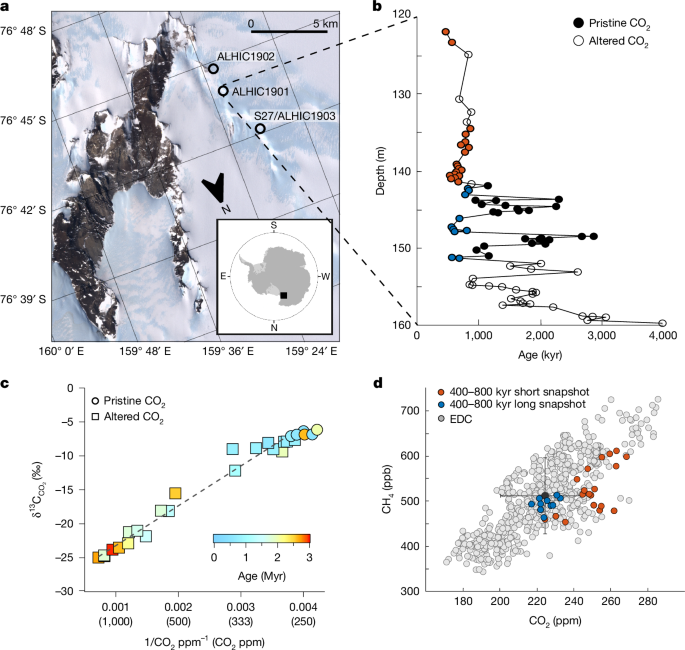
This study presents a new record of atmospheric carbon dioxide (CO2) and methane (CH4) levels spanning the past 3.1 to 0.5 million years, using ice core samples from the Allan Hills Blue Ice Area in Antarctica. The key findings are:
- CO2 levels showed a small decline of about 20 ppm between 2.9 Ma and 1.2 Ma, followed by stable concentrations (±10 ppm) across the Mid-Pleistocene Transition.
- CH4 levels were broadly stable over the entire 3 million year period.
- These results provide the first long-term perspective on greenhouse gas evolution before 800,000 years ago, extending the ice core record back in time.
Methodology
- Researchers collected discontinuous ice core "snapshots" from the Allan Hills Blue Ice Area in Antarctica, covering the time period from 3.1 to 0.5 million years ago.
- They measured CO2 and CH4 concentrations in these samples using established analytical techniques for ice core gas analysis.
- To account for potential biases due to post-depositional processes, the team corrected CO2 values in some samples using stable carbon isotope (δ13C) measurements.
Results
CO2
- CO2 levels showed a small decline of about 20 ppm between 2.9 Ma and 1.2 Ma.
- From 1.2 Ma to 0.5 Ma, CO2 concentrations remained relatively stable, within ±10 ppm.
- Corrected CO2 values from older samples (2.8-3.1 Ma) were indistinguishable from the early Pleistocene, with a mean of 250 ± 10 ppm.
CH4
- CH4 levels were broadly stable over the entire 3 million year period, showing no marked change in the mean concentration.
Limitations
- The discontinuous nature of the ice core snapshots means the records may not capture the full amplitude of glacial-interglacial variations.
- Post-depositional processes in the Blue Ice Area likely affect the gas concentrations, requiring isotopic corrections.
- The age control relies on the 40Ar/36Ar chronology, which has an uncertainty of ±11%.
Interpretation
- The stable CO2 and CH4 levels over most of the Pleistocene suggest the global carbon cycle was in a quasi-steady state, not exhibiting the large glacial-interglacial swings seen in the late Pleistocene.
- The small CO2 decline between 2.9-1.2 Ma may have contributed to the onset of the larger amplitude glacial cycles during the Mid-Pleistocene Transition.
- The absence of major greenhouse gas variations contrasts with the substantial climate changes inferred from other proxy records over this time period, suggesting the climate system was less sensitive to orbital forcing prior to the mid-Pleistocene.
What Comes Next
- Further investigation of the CO2 and CH4 records from other Antarctic blue ice sites could help resolve the full amplitude of greenhouse gas variations during the early and mid-Pleistocene.
- Improved dating and gas extraction techniques may allow more continuous greenhouse gas records to be developed from these ancient ice samples.
- Integrating the new ice core data with Earth system models and other paleoclimate proxies will be crucial for understanding the complex interplay between the carbon cycle, climate, and glacial-interglacial cycles over the Plio-Pleistocene.
Sources: