Story
Giant energy storage and dielectric performance in all-polymer nanocomposites
Key takeaway
Researchers created a new kind of polymer material that can store a lot of energy, which could lead to improved batteries and energy storage devices for homes and electric vehicles.
Quick Explainer
The researchers developed a novel type of all-polymer nanocomposite material with a self-assembled three-dimensional nanomorphology. This unique structure enables the material to simultaneously achieve a high dielectric constant, high breakdown strength, and low electrical losses across a wide temperature range. The key is that the immiscible blend of two dipolar polymers spontaneously forms these nanostructured interfaces, which act as barriers to mobile charges, reducing energy dissipation at high fields and temperatures. This allows the nanocomposite to outperform conventional polymer-based dielectrics, achieving record-high energy storage densities even at elevated temperatures up to 250°C.
Deep Dive
Technical Deep Dive: Giant Energy Storage in All-Polymer Nanocomposites
Overview
This work introduces a novel approach to develop high-performance dielectric polymers for electrical energy storage applications. The key contributions are:
- Synthesized all-polymer nanocomposites with self-assembled three-dimensional nanomorphologies, enabling concurrent high dielectric constant (K > 13), high breakdown strength, and low loss across a wide temperature range (up to 250°C).
- Demonstrated record-high discharged energy densities of 18.7 J/cm³ at 150°C, 15.1 J/cm³ at 200°C, and 8.6 J/cm³ at 250°C.
- Showed that the all-polymer nanocomposites outperform state-of-the-art polymer and polymer composite dielectrics for high-temperature capacitive energy storage.
Motivation & Context
- Dielectric polymers used in electrical energy storage require a combination of high dielectric constant (K), low loss, and high breakdown strength, while capable of operating at high temperatures.
- Decades of research into polymer-inorganic composites have achieved only limited success in reaching these goals.
- This work addresses the urgent need for high-energy-density polymer dielectrics that can operate across a broad temperature range.
Methodology
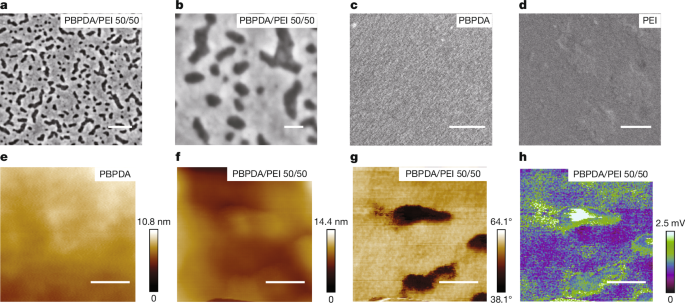
- Developed high-temperature immiscible blends of two dipolar polymers (PBPDA and PEI) that self-assemble into three-dimensional all-polymer nanocomposites.
- The resulting nanostructures induce coiled-chain morphology and large conformation changes, which, combined with the relatively low rotational barrier and high dipole moments of both polymers, yield ultrahigh dielectric responses.
- The nanostructured interfaces act as barriers for mobile charges, reducing conduction losses at high fields and temperatures.
Data & Experimental Setup
- Fabricated PBPDA/PEI nanocomposite films with varying blend ratios.
- Characterized the morphology using SEM, SAXS, and AFM-IR techniques.
- Measured the dielectric properties, charge-discharge performance, and thermal stability over a wide temperature range (25-250°C).
- Compared the results to state-of-the-art polymer and polymer composite dielectrics reported in the literature.
Results
- The PBPDA/PEI 50/50 wt% blend exhibited:
- Dielectric constant (K) > 13, with low loss (tan δ ≈ 0.002) across a wide temperature range.
- Discharged energy densities of 18.7 J/cm³ at 150°C, 15.1 J/cm³ at 200°C, and 8.6 J/cm³ at 250°C.
- Excellent charge-discharge cycling stability, maintaining high efficiency (> 90%) after 50,000 cycles at 200°C.
- Outperformed state-of-the-art polymer and polymer composite dielectrics reported in the literature across the entire temperature range.
Interpretation
- The self-assembled three-dimensional all-polymer nanocomposite structure enables:
- Coiled-chain morphology and large conformation changes, leading to high dielectric constant.
- Nanostructured interfaces that act as barriers for mobile charges, reducing conduction losses at high fields and temperatures.
- The combination of high dielectric constant, high breakdown strength, and low loss allows the PBPDA/PEI nanocomposites to achieve record-high discharged energy densities at elevated temperatures.
Limitations & Uncertainties
- The work focused on a specific polymer blend (PBPDA/PEI); the generalizability to other immiscible dipolar polymer blends was not fully demonstrated.
- The underlying mechanisms for the coiled-chain morphology and charge transport behavior at the nanoscale interfaces were not investigated in-depth.
- The long-term reliability and stability of the nanocomposites under harsh operating conditions (e.g., high electric fields, high temperatures, cycling) require further study.
Next Steps
- Explore the applicability of the all-polymer nanocomposite approach to a broader range of immiscible dipolar polymer blends.
- Conduct deeper investigations into the nanoscale morphology formation and charge transport mechanisms to further optimize the dielectric performance.
- Assess the long-term reliability and operational stability of the nanocomposites under realistic high-temperature, high-field, and cycling conditions.
- Explore scalable manufacturing methods for large-area, high-performance dielectric films.
Sources: [1] Nature News article "Giant energy storage and dielectric performance in all-polymer nanocomposites"