Story
Outer Diversity of Structured Domains
Key takeaway
Researchers found that a certain type of mathematical domain allows for more diverse voter preferences in elections, which could lead to better representation of people's views.
Quick Explainer
The paper introduces "outer diversity" as a new way to measure the diversity of preference order domains, such as those seen in voting theory. Rather than focusing on the internal structure of a domain, outer diversity looks at how spread out the rankings within a domain are across the full space of all possible rankings. This is done by computing the expected distance between a randomly sampled ranking and the closest ranking in the domain. The authors provide efficient algorithms to calculate outer diversity for several well-known structured domains, finding that domains with exponential size like group-separable preferences based on caterpillar trees maintain high diversity as the number of candidates increases, in contrast to polynomial-sized domains like single-crossing preferences.
Deep Dive
Technical Deep Dive: Outer Diversity of Structured Domains
Overview
This technical deep-dive briefing summarizes the key findings from the paper "Outer Diversity of Structured Domains" (arXiv preprint). The work introduces a new measure of diversity for preference order domains, called "outer diversity", and analyzes the diversity of several well-known structured domains in voting theory.
Problem & Context
- In the standard ordinal model of elections, voters provide ranked preferences over a set of candidates.
- Some rankings appear more "rational" or natural than others, leading to the study of "structured domains" - subsets of the full preference order space that capture different notions of rational behavior.
- Examples of structured domains include single-peaked, single-crossing, and group-separable preferences.
- Prior work has proposed measures of domain diversity, including "richness diversity" and "inner diversity", but the authors introduce a new notion of "outer diversity" as an alternative.
Methodology
- The key idea behind outer diversity is to measure how spread out a domain's rankings are within the full space of all possible rankings, rather than focusing on the internal structure of the domain itself.
- Outer diversity is defined as the expected swap distance between a randomly sampled ranking and the closest ranking in the domain, normalized to be between 0 and 1.
- The authors provide efficient algorithms for computing outer diversity for various structured domains, including single-peaked, single-crossing, group-separable, and Euclidean domains.
Results
- Analyzing outer diversity for 8 candidate elections:
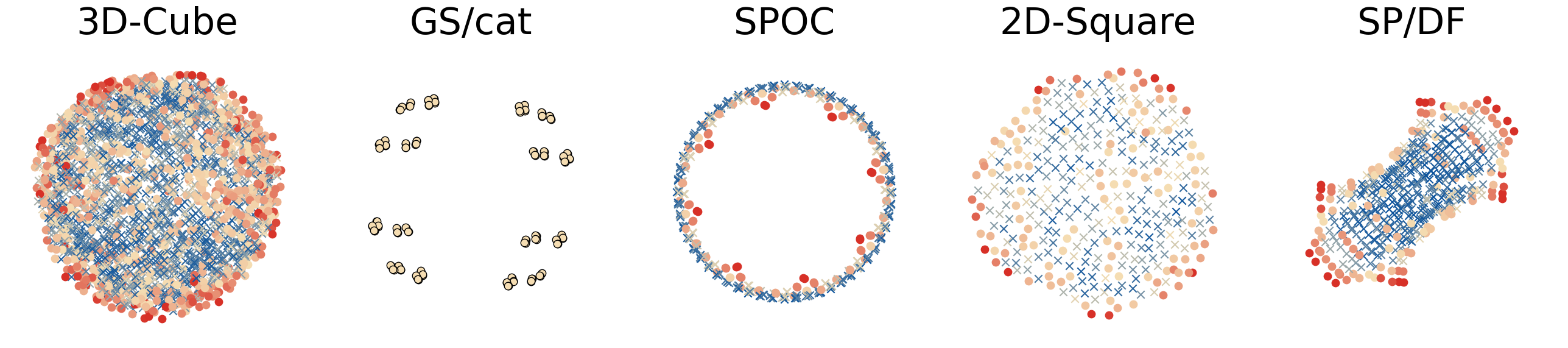
- The group-separable domain based on caterpillar trees (GS/cat) and the 3D Euclidean domain are the most diverse.
- The single-crossing (SC) and 1D Euclidean (1D-Int.) domains are the least diverse.
- The rankings within group-separable domains (GS/bal, GS/cat) have uniform popularity, while other domains show more variance.
- Outer diversity generally decreases as the number of candidates increases, but GS/cat remains the most diverse for 12 or more candidates.
- Domains with exponential size (like GS/cat) maintain non-zero outer diversity as the number of candidates grows, while polynomial-sized domains (like SC, 2D-Square) see their diversity drop to near-zero.
Limitations & Uncertainties
- The algorithms for computing outer diversity have varying time complexities, with some requiring solving NP-hard problems for certain domains.
- The analysis is limited to up to 20 candidates, and the behavior for larger numbers is not explored.
- The relationship between outer diversity and other notions of diversity, like inner diversity, is not fully formalized.
What Comes Next
- Investigating the theoretical properties and limits of outer diversity as a measure of domain diversity.
- Extending the analysis to larger numbers of candidates and exploring the convergence properties of outer diversity.
- Establishing formal connections between outer diversity and other diversity measures used in computational social choice.