Story
First Observation of CO$_2$ Emission and foreground absorption Toward the Galactic Center with JWST
Key takeaway
The James Webb Space Telescope has observed carbon dioxide in the center of our galaxy for the first time, providing new insights into the composition and chemistry of this mysterious region.
Quick Explainer
The study used JWST's mid-infrared spectrograph to observe regions in the Galactic Center, detecting absorption and emission from gas-phase CO₂, C₂H₂, and HCN, as well as solid CO₂ ice. By modeling the CO₂ absorption features, the researchers derived the temperature, velocity, and column density of the CO₂ gas, which likely originates from one or more extended foreground molecular clouds. Notably, the authors also detected a point-like CO₂ emission source coincident with a known M-giant star, potentially associated with a compact companion in a symbiotic binary system. This work represents the first observation of gas-phase CO₂ in the Galactic Center region using JWST's advanced infrared capabilities.
Deep Dive
Technical Deep Dive
Overview
This study presents the first observation of gas-phase CO₂ absorption and emission toward the Galactic Center using the James Webb Space Telescope (JWST). In addition to CO₂, the authors also detect absorption from gas-phase C₂H₂ and HCN, as well as CO₂ ice, across two observed fields.
Methodology
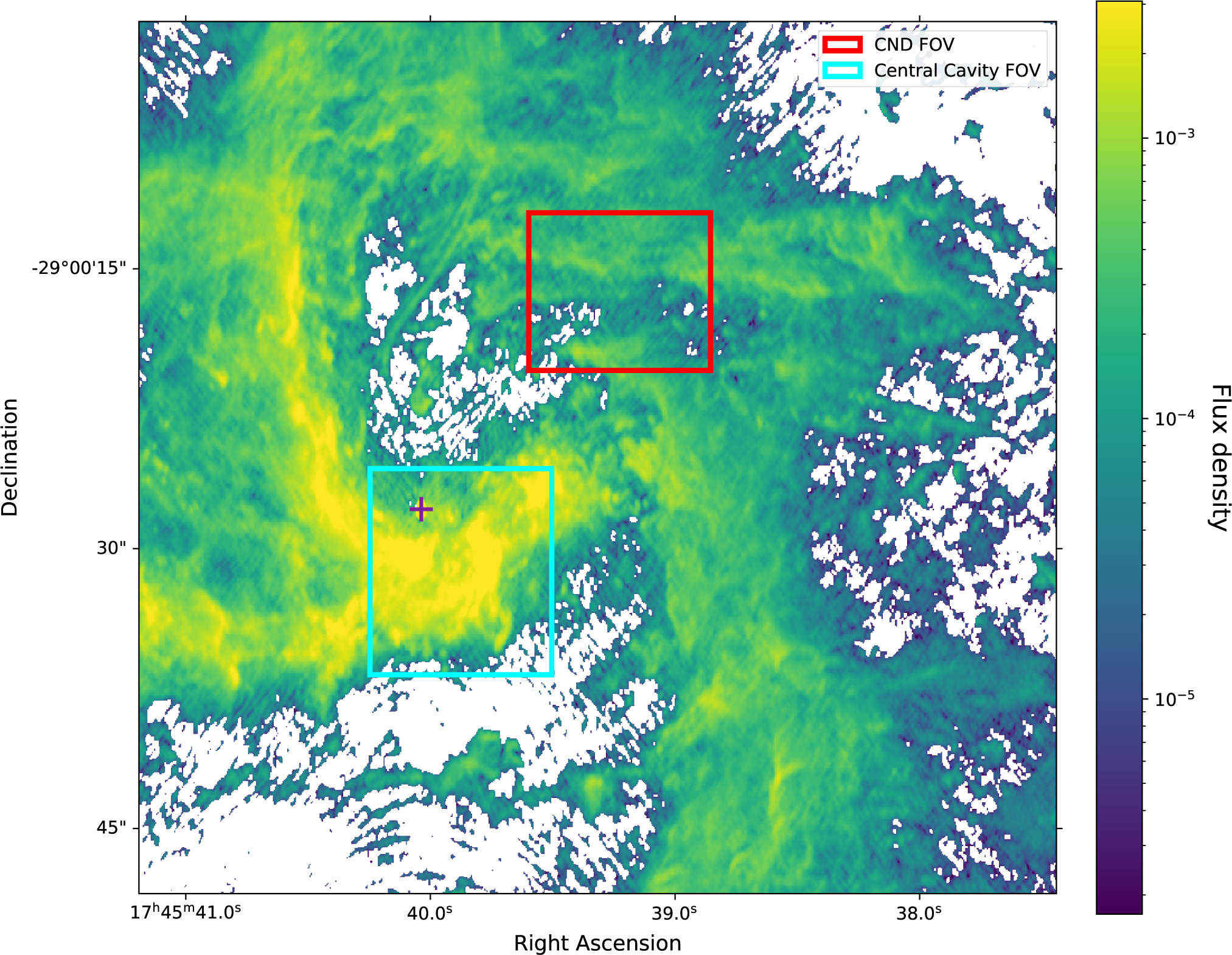
- The authors used JWST's mid-infrared integral field spectrograph MIRI/MRS to observe two fields in the Galactic Center region: one in the Circumnuclear Disk (CND) and one in the central cavity (CC) of the CND.
- They fit the observed CO₂ absorption features using a local thermodynamic equilibrium (LTE) model to derive the temperature, radial velocity, and column density of the CO₂ gas.
- The authors also analyzed the spatial variation of the CO₂ column density and detected a point-like CO₂ emission source coincident with the known M-giant star IRS 11SW.
- In addition, they estimated the column densities of C₂H₂ and HCN from their absorption features.
- The authors also measured the column density of solid CO₂ ice across the fields.
Results
- The CO₂ gas has a temperature between 20-50 K and a column density of around 2×10¹⁵ cm⁻².
- The C₂H₂ gas has a similar column density to CO₂ but a higher temperature of ~100 K, while HCN has a lower temperature of ~10 K.
- The CO₂ ice column density corresponds to an ice-to-gas ratio of ~90.
- The CO₂ absorption likely originates from one or more extended foreground molecular cloud(s) at distances between 0.15 and 4 kpc from Earth.
- The authors also detected a point-like CO₂ emission source coincident with the M-giant star IRS 11SW, which may be associated with a symbiotic binary system.
Interpretation
- The authors conclude that the observed absorption features are most likely produced by one or more foreground molecular clouds, based on the radial velocities consistent with zero and the similar column densities between the two observed fields.
- The clumpy nature of the clouds is suggested by the spatial variations in CO₂ column density up to a factor of 2.
- The CO₂ emission associated with IRS 11SW is likely produced by the circumstellar environment of this M-giant star, potentially related to a compact companion.
Limitations & Uncertainties
- The authors note that the temperature uncertainties are not straightforward to calculate due to the correlation between temperature and line normalization.
- The HCN column density uncertainties are larger due to the complex baseline in that spectral region.
- The authors also performed non-LTE modeling to assess the potential impact of radiative pumping, but found it to be negligible for the conditions likely present in the foreground clouds.
What Comes Next
- Future observations of other Galactic Center environments and IR-bright regions could further improve our understanding of the distribution and physical conditions of gas-phase and solid-state CO₂.
- Investigating the relationship between the gas-phase and ice-phase CO₂ across a larger sample of sightlines may provide insights into gas-grain interactions within molecular clouds.