Story
AIFL: A Global Daily Streamflow Forecasting Model Using Deterministic LSTM Pre-trained on ERA5-Land and Fine-tuned on IFS
Key takeaway
Researchers have created a global daily streamflow forecasting model that can predict flooding and water availability more accurately by combining climate data and machine learning. This can help communities better prepare for floods and manage water resources.
Quick Explainer
AIFL is a high-performing global streamflow forecasting model that bridges the gap between reanalysis data and operational weather forecasts. It uses a two-stage training approach: first pre-training on historical reanalysis data to learn fundamental hydrological processes, then fine-tuning on operational forecast data to adapt to real-world error structures. This novel strategy allows AIFL to leverage the strengths of both data sources, resulting in reliable streamflow predictions, particularly for extreme flood events. AIFL's transparent and reproducible architecture makes it a valuable baseline for the global hydrological community.
Deep Dive
AIFL: A Global Daily Streamflow Forecasting Model Using Deterministic LSTM Pre-trained on ERA5-Land and Fine-tuned on IFS
Overview
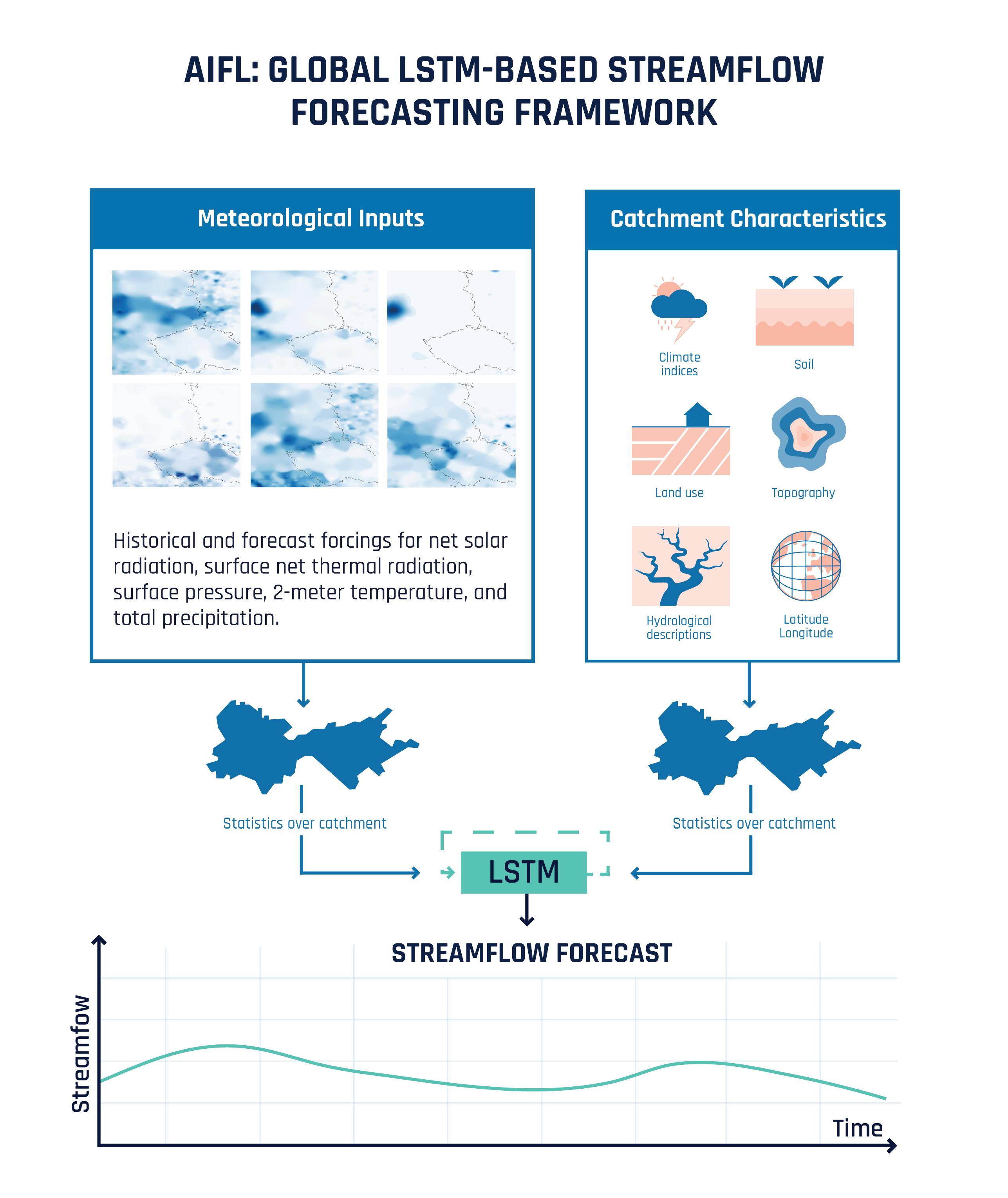
This paper introduces AIFL (Artificial Intelligence for Floods), a deterministic LSTM-based model designed for global daily streamflow forecasting. AIFL utilizes a novel two-stage training strategy to bridge the reanalysis-to-forecast domain shift:
- Pre-training on 40 years of ERA5-Land reanalysis (1980–2019) to capture robust hydrological processes.
- Fine-tuning on operational Integrated Forecasting System (IFS) control forecasts (2016–2019) to adapt to the specific error structures and biases of operational numerical weather prediction.
On an independent temporal test set (2021–2024), AIFL achieves high predictive skill with a median modified Kling–Gupta Efficiency (KGE') of 0.66 and a median Nash-Sutcliffe Efficiency (NSE) of 0.53. AIFL demonstrates exceptional reliability in extreme-event detection, providing a streamlined and operationally robust baseline for the global hydrological community.
Problem & Context
- Reliable global streamflow forecasting is essential for flood preparedness and water resource management, yet data-driven models often suffer from a performance gap when transitioning from historical reanalysis to operational forecast products.
- Existing models are fundamentally constrained by the characteristics of their forcing data, and addressing the reanalysis-to-forecast domain shift is a prerequisite for reliable operational deployment.
Methodology
Model Architecture
- AIFL employs a single-layer LSTM network with separate feedforward embedding networks for dynamic and static input features.
- The architecture was selected based on spatial validation, with a 1,024-unit LSTM demonstrating higher representational capacity compared to a smaller 256-unit model.
Training Strategy
- Two-stage transfer learning strategy:
- Pre-training on ERA5-Land reanalysis (1980–2019) to learn universal hydrological response functions.
- Fine-tuning on IFS control forecasts (2016–2019) to adapt to operational forecast error structures and biases.
- Normalized MSE loss function to ensure equal basin contribution.
Data & Experimental Setup
- Curated dataset of 18,588 basins from the CARAVAN dataset, after deduplication and quality control.
- Dynamic inputs: 5 meteorological variables (precipitation, temperature, radiation, pressure) from ERA5-Land and IFS.
- Static inputs: 203 catchment attributes describing physiography, soil, geology, land cover, climate, and anthropogenic influence.
- Temporal test set of 2,003 basins with continuous observations from 2021-2024.
Results
Temporal Generalization
- Median KGE' of 0.66 and median NSE of 0.53 on the 2021-2024 test set.
- Outperforms the GloFAS v4 operational system, which reports a median KGE' of 0.70.
- Benchmark against the Google global flood model:
- AIFL matches or exceeds Google skill at 42.9% of the 1,218 shared stations.
- Performance varies systematically with basin size, with AIFL superior in smaller catchments.
Flood Event Performance
- Strict zero-false-alarm behavior, with precision of 1.0 across all return periods (1.5 to 50 years).
- Captures approximately half of frequent (1.5-2 year) events and a third of 50-year extremes.
- Reliable early warning demonstrated in a case study of the January 2024 Belgium floods.
Interpretation
- The two-stage training strategy effectively bridges the reanalysis-to-forecast domain shift, mitigating systematic biases in operational forcing data.
- AIFL's transparent, reproducible architecture and competitive skill establish it as a viable global streamflow forecasting baseline.
- Prioritizing precision over sensitivity in extreme event detection is a critical property for operational early warning systems.
Limitations & Uncertainties
- Performance varies across basin sizes and hydroclimatic regimes, with lower skill in arid/semi-arid regions and intermittent flow regimes.
- Improving recall for rare extremes without compromising the current zero-false-alarm behavior remains an important direction for future development.
- Integration of probabilistic ensemble forcing could further refine event detection and support risk-based decision-making.
What Comes Next
- Transition toward distributional objectives to enable inherent uncertainty quantification.
- Investigate the impact of multi-source precipitation products on improving recall for rare extremes.
- Explore strategies to better leverage sparse records available for operational testing across all spatial scales.